Air Cleaner vs. Air Purifier: Is There a Difference? (And Which One Do You Need?)

TL;DR: In the commercial world, "air cleaner," "air purifier," "air scrubber," and "smoke eater" are mostly marketing labels. What actually determines whether a machine solves your problem is physics: how much air it moves (CFM), what media it pushes that air through (HEPA for particles, pounds of activated carbon for odors and gases), and whether it's built from steel to run 24/7. The EPA treats "air cleaner" as the umbrella term and "air purifier" as one type of air cleaner. Ignore the sticker on the box and read the spec sheet.
If you are browsing catalogs or scrolling through search results trying to improve the air quality in your business, you have likely hit a wall of terminology. Some units are labeled "Air Cleaners." Others are labeled "Air Purifiers." You'll also see "scrubbers," "sanitizers," and "ionizers." Some manufacturers use the terms interchangeably; others insist there is a massive difference.
For a business owner trying to mitigate welding fumes in a shop, cigar smoke in a lounge, or viral vectors in a waiting room, this ambiguity is frustrating. You don't have time for a linguistics lesson; you just need the air to be safe and clean.
Here is the reality: in the commercial sector, the difference between an air cleaner and an air purifier isn't really about marketing — it's about the level of filtration and the intent of the machine. At Commercial Air Purifiers, we believe in "overkill" engineering. A plastic device designed to "clean" a bedroom won't survive a week in a busy bar or a dusty warehouse. In this guide, we cut through the jargon, explain the technical differences, and help you choose the right equipment based on physics, not product names.
What the EPA Actually Says
To settle the debate, look at the regulatory definition. The U.S. Environmental Protection Agency (EPA) uses the term "air cleaner" as the broad, umbrella category — any device that removes pollutants from indoor air. Under that definition, an "air purifier" is simply a specific type of air cleaner.
In the marketplace and the HVAC trade, though, the terms have drifted to signal different form factors:
- "Air Cleaner" usually implies a device integrated into a central HVAC system (a media cabinet or electronic air cleaner in the ductwork) or a simple mechanical filter designed to catch dust. It's associated with "whole-building" solutions.
- "Air Purifier" usually implies a standalone, portable, or ceiling-mounted unit that targets specific pollutants — smoke, odors, viruses — using higher-grade filtration like HEPA and activated carbon.
According to the EPA, indoor air quality can be two to five times more polluted than outdoor air. In a commercial setting with chemicals, manufacturing byproducts, or biological aerosols present, that number can climb higher. Whether you call the machine a cleaner or a purifier, the goal is the same: reduce the particulate and chemical load in the environment.
The Core Distinction: A Filtration Hierarchy
Industry practice generally draws the line based on the size of the particle being removed and the method used to remove it.
What an "Air Cleaner" Targets
- Target: Dust, pollen, lint, and pet dander.
- Technology: Fibrous filters (like pleated MERV filters) or electrostatic precipitation.
- Goal: To clear the air of the "stuff" you can see floating in a sunbeam.
What an "Air Purifier" Targets
- Target: Bacteria, viruses, mold spores, Volatile Organic Compounds (VOCs), chemical off-gassing, and smoke odors.
- Technology: Medical-grade HEPA media, significant amounts of activated carbon, and sometimes UV-C light.
- Goal: To purify the environment for health and safety compliance.
In short: an air cleaner keeps your shelves free of dust. An air purifier keeps your lungs free of toxins.
The Big Fork: HVAC-Integrated vs. Standalone
The single biggest source of confusion is that "air cleaner" often means a filter that lives inside your central HVAC system, while "air purifier" usually means a standalone machine with its own motor. These are fundamentally different tools.
The HVAC-Integrated "Air Cleaner"
When a contractor offers to install an "air cleaner," they typically mean a media cabinet or an electronic air cleaner (EAC) that slides into your ductwork near the furnace or air handler. It relies on the blower motor of your central system — air gets filtered only as it circulates for heating or cooling. Its limitations are real:
- Static pressure: Central HVAC is designed to move air for temperature control, not dense filtration. Put a HEPA filter into an HVAC slot and it creates too much resistance — airflow chokes, the motor strains, and coils can freeze. That's why most integrated "air cleaners" use lower-efficiency MERV 8–13 media that catches dust but misses fine smoke and viruses.
- Dependency: It only cleans when the heat or AC is running. When the thermostat is satisfied, the air stops moving and the cleaning stops.
- Dilution, not extraction: It slowly treats the whole building. It is poor at handling a specific source of pollution, like a cigar smoker or a printer in one room.
The Standalone Commercial "Air Purifier"
A commercial air purifier (or air scrubber) has its own dedicated, high-torque motor. It doesn't care about your thermostat — it sits in the room with the pollution source and recirculates that zone's air continuously. That independence is exactly what makes "overkill" filtration possible:
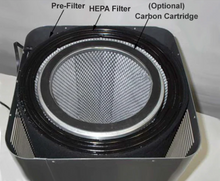
- Dense media without penalty: Its own motor can push air through True HEPA (99.97% efficiency) and massive beds of activated carbon without restricting a building's central airflow.
- High velocity: It can be sized to turn a specific room's air over 15 times an hour, versus the 2–4 air changes a typical HVAC cleaner manages.
- Real odor removal: Central cleaners rarely hold enough carbon to stop odors. Standalone commercial purifiers can carry 30+ pounds of carbon, making them legitimate smoke eaters.
The "Purifier" Marketing Trap: Filtration vs. Sanitization
Another layer of confusion comes from marketing departments trying to differentiate their products by claiming they "purify" (sanitize) rather than merely "clean" (filter). You'll see devices sold as purifiers because they add technologies like:
- UV-C light: claims to kill bacteria and viruses as air passes the lamp.
- Ionization: claims to charge particles so they drop out of the air.
- PCO (photocatalytic oxidation): claims to destroy VOCs on a coated surface.
These technologies have their place, but in a commercial setting mechanical filtration — physically trapping the contaminant in a filter — is still the gold standard. ASHRAE recognizes mechanical filtration (HEPA) as the primary, most reliable method of particle removal. Just as important: many "filterless" purifiers generate ozone as a byproduct, and the EPA warns against running ozone generators in occupied spaces. Our position is simple — a machine is only a true purifier if it removes the contaminant from the room using HEPA and carbon. Zapping a particle with light is secondary to trapping it in a filter and carrying it out of the building.
The Two Metrics That Actually Matter
Forget "cleaner" vs. "purifier" for a moment. Judge any unit by two non-negotiable standards: CFM and media.
1. CFM (Power)
This is the single most important number on any spec sheet. CFM stands for Cubic Feet per Minute — the volume of air the machine can pull through its filters. A residential "air cleaner" might move 100 to 300 CFM, fine for a quiet bedroom. But in a commercial space fighting a constant pollution source, you need to exchange the room's air multiple times per hour. If you don't have enough CFM, the pollutant enters the room faster than the machine can remove it, and you've wasted your money.
(Note: for small residential appliances you'll often see CADR — Clean Air Delivery Rate — instead of CFM. In the commercial world, raw CFM is the number that matters.)
The math is simple:
Room Volume (L × W × H) × Desired ACH ÷ 60 = Required CFM
Example: a smoking lounge measuring 20 × 20 × 10 (4,000 cubic feet) that needs 15 air changes per hour requires (4,000 × 15) ÷ 60 = 1,000 CFM. A unit that only moves 200 CFM will fail here no matter what the box calls it.
Do the math, don't guess. Use our CFM Calculator to input your room dimensions and ceiling height. It tells you exactly how much airflow is required to hit the necessary Air Changes Per Hour (ACH) for your industry.
2. Media (Filtration)
Once the air is inside the box, what happens to it?
- For particulates (the "cleaner" job): You need surface area. Commercial units use deep-pleated or bag filters that hold pounds of dust before restricting airflow.
- For sanitization (the "purifier" job): You need HEPA. As defined by the CDC, HEPA filters remove at least 99.97% of particles at 0.3 microns — dust, pollen, mold, and bacteria included.
- For odors and gas: You need activated carbon, which adsorbs chemicals like a sponge. A residential unit might have a carbon "sheet" weighing a few ounces that saturates in days. A commercial unit uses deep-bed canisters weighing 10, 20, or 30 pounds. If you're removing smoke or chemicals, the word "purifier" means nothing without the physical weight of carbon required.
Residential Plastic vs. Commercial Steel: The "Overkill" Philosophy
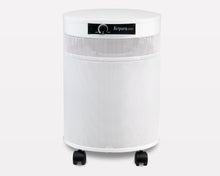
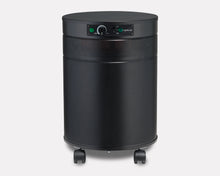
The biggest confusion between cleaners and purifiers comes from the residential market. You can buy a $100 "air purifier" at a big-box store — plastic, ten pounds, nice-looking. In a commercial environment, that unit is a toy. Commercial spaces are hostile, so we build for them:
- Duty cycle: A commercial unit must run 24/7/365. Residential motors burn out under that load.
- Housing: Our units use powder-coated steel, not plastic. Plastic is porous — in a smoking environment or nail salon it absorbs odors and the machine itself starts to smell after a year. Steel is non-porous; wipe it down and it's like new. It also survives being bumped by carts, kicked by customers, or mounted in ceilings.
- Maintenance: A commercial unit is designed to be serviced. Swap out pre-filters to protect the expensive main filters, instead of trashing the whole cartridge every few months.
Which Technology Do You Need?
Identify your primary enemy, then match it to the tool.
| Your primary problem | What to buy | Why |
|---|---|---|
| Visible dust & debris (warehouse, woodshop, manufacturing) | Commercial air cleaner / dust collector | High CFM plus high-capacity pre-filters. You rarely need carbon and only need HEPA if the dust is toxic (e.g., silica). |
| Smoke, odors & fumes (cigar lounge, dispensary, print shop, nail salon) | Commercial smoke eater (heavy-duty purifier) | Smoke is both tar (solid) and gas (smell). You need activated carbon to adsorb the VOCs that cause odor — a plain cleaner leaves the smell behind. |
| Viruses, bacteria & allergens (dental, school, gym, waiting room) | Commercial HEPA air purifier | Biological safety needs certified True HEPA (99.97%). ASHRAE recommends high-efficiency filtration to mitigate infectious aerosols; a standalone unit delivers it without choking your HVAC. |
General background dust in a normal home is the one case where an HVAC-integrated MERV 11–13 air cleaner is genuinely the right, quiet, whole-house call. Everything on the commercial side of the ledger wants a standalone machine.
Frequently Asked Questions
Can an air cleaner also be an air purifier? Yes. The best commercial units are hybrids. Our smoke eaters are powerful air cleaners (removing visible smoke) combined with air purifiers (removing invisible odors via carbon and particulates via HEPA). The terminology matters less than the filter configuration.
Is an air scrubber the same as an air purifier? In the trade, "air scrubber" usually means a rugged, ductable, portable unit for construction sites (negative-air machines). Functionally it's the same technology — motor plus HEPA — packaged to be thrown in a truck. A commercial air purifier is often the same engine packaged for a ceiling mount or finished space.
Is a HEPA filter a cleaner or a purifier? Technically a purifier component. Because HEPA captures particles down to 0.3 microns, it elevates a plain "cleaner" to "purifier" status. A unit with only a MERV 8 filter is just an air cleaner.
Do I need a purifier if my building has HVAC? Usually yes. Most commercial HVAC is designed for temperature control, not contaminant removal, and standard HVAC filters protect the equipment, not the people. The ideal setup runs a MERV 13 filter in the central system for background dust and a standalone commercial purifier in high-pollution zones for the heavy lifting.
Are commercial units louder? Not necessarily. A commercial unit running on low can move more air than a residential unit on its highest setting, and often more quietly. At full power a commercial machine is moving 1,000+ CFM, and the sound of that much moving air is unavoidable — we consider it the sound of performance. Sizing the unit correctly usually means you can run it on a lower, quieter speed.
Why are commercial units more expensive? You're paying for metal, motors, and media. A residential unit might have one pound of carbon and a plastic fan; a commercial unit might have 22 pounds of carbon, steel casing, and a motor moving 1,000+ CFM. It's the difference between a golf cart and a dump truck.
The Final Verdict
Don't get hung up on the words "cleaner" or "purifier" — in the commercial sector those labels are often just stickers on a box. Focus on the physics:
- Identify the pollutant: Is it dust (particulate) or smell (gas)?
- Calculate the power: Use the CFM Calculator to determine the airflow you need.
- Choose the media: HEPA for health, carbon for odor.
When you ignore the marketing fluff and focus on "overkill" engineering, you ensure your employees are safe, your customers are comfortable, and your business stays compliant. Stop guessing with residential toys — browse our commercial smoke eaters and air scrubbers and get a machine built for business.
Related guides
- Air Ionizer vs. Air Purifier: Why Mechanical Power Wins
- Air Mist Purifiers: Do Water-Based Purifiers Work?
- CADR, ACH & MERV Explained: Air Purifier Specs
- MERV vs. HEPA: Commercial Filtration Standards Compared
Ready to improve your air quality? Explore our Air Cleaners & Purifiers collection, or contact our team for a recommendation tailored to your space.