Beyond the Bar Top: The Expert's Guide to Air Quality for Your Home Bar

By the Experts at Commercial Air Purifiers | Published: October 30, 2025
A well-appointed home bar is more than just a place to pour a drink; it’s the heart of your home’s social life. It’s the clinking of glasses, the murmur of conversation, the right music setting the mood. It’s a space meticulously designed for comfort and camaraderie. Yet, an invisible element can quickly undermine the entire experience: the quality of the air. A stuffy, stagnant feeling from a crowd, the stale odor from last night’s gathering, or the unmistakable haze of tobacco smoke can turn a premium retreat into an unpleasant space.
A great host thinks about the drinks, the lighting, and the playlist. A legendary host also thinks about the air. As air quality engineers, we know that a home bar presents a uniquely complex set of challenges that a standard appliance simply can’t handle. This is your professional guide to understanding the distinct layers of pollutants in a bar environment and engineering an air purification strategy that ensures your space is always fresh, clean, and invigorating for every occasion.
The Anatomy of Bar Air: A Complex Cocktail of Pollutants
The air in an active home bar is a dynamic and challenging environment, far more complex than that of a typical living room. It’s a space subject to a "cocktail" of pollutants from biological, chemical, and particulate sources, all mingling in the air.
1. The Biological Load (People & Place): A successful bar is a crowded one. A high density of people breathing, talking, and laughing in an enclosed space releases a significant bio-load into the air, including carbon dioxide, body odors, and bioaerosols that can carry viruses and bacteria. Furthermore, home bars are often located in basements, which are naturally prone to higher humidity. This can introduce mold and mildew spores, which contribute to a musty, unhealthy environment.
2. The Chemical Load (Drinks, Furnishings & Smoke): This is often the most significant challenge. Volatile Organic Compounds (VOCs) are released from a wide array of sources. The evaporation of spilled beer, wine, and spirits releases ethanol and other organic compounds. The very materials of your bar—the sealants on the wood, the adhesives in the cabinetry, the stain repellents on the furniture—can off-gas chemicals for months or years. And if smoking is permitted, you introduce thousands of additional toxic VOCs, which are the primary source of the pervasive tobacco odor. The U.S. Environmental Protection Agency (EPA) has extensively documented the wide range of sources for these indoor air pollutants.
3. The Particulate Load (Dust & Smoke): Every social gathering kicks up dust, clothing fibers, and other fine particles into the air. If the bar is also a smoking lounge, this is compounded by a massive influx of particulate matter from the smoke itself. This is the tar and ash that creates the visible haze, irritates the lungs, and eventually settles as a sticky, damaging residue on your bar, bottles, and furniture.
Engineering Your Bar's Atmosphere: The Right Technology for Each Threat
To conquer this complex cocktail of pollutants, you need a multi-faceted solution. A high-performance air purifier for a bar environment must be equipped with a robust, multi-stage filtration system designed to neutralize each specific category of threat.
Conquering Odors and Chemicals (The Gaseous Threat)
The most common complaint in a home bar is the "morning-after" smell—a stale, lingering odor that is a combination of old drinks, food, and potential smoke. These smells are caused by gaseous VOCs and cannot be captured by a standard particle filter.
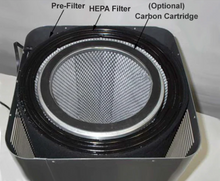
The definitive technology for removing these pollutants is adsorption by activated carbon. A proper activated carbon filter has an incredibly porous structure, creating a vast internal surface area—a single pound can have a surface area of over 100 acres. As the polluted air is forced through this carbon bed, the gaseous VOC molecules are trapped and chemically bonded to the surface. For the heavy and diverse chemical load of a home bar (especially one where smoking occurs), the quantity of carbon is non-negotiable. A flimsy, coated filter will become saturated almost instantly. A true bar-grade system requires a deep-bed filter with 15 to 25 pounds of virgin activated carbon to provide the capacity needed for total, continuous odor elimination.
Clearing the Air of Particulates (The Physical Threat)
The visible haze, the fine layer of dust on your bar top, and the most hazardous components of smoke are all physical particles. These require a physical barrier to remove.
The gold standard for particle capture is the True HEPA filter. This is a medical-grade filter certified to remove 99.97% of all airborne particles down to 0.3 microns. In your bar, its benefits are threefold:
-
It Removes Dust: It captures all the ambient dust and fibers kicked up by guests, keeping surfaces cleaner.
-
It Eliminates Smoke Haze: For smoking bars, the HEPA filter is what physically removes the tar and ash particles from the air, eliminating the haze and reducing the health risks documented by the CDC.
-
It Creates a Healthier Social Space: This is a crucial, often-overlooked benefit. The same HEPA filter that captures dust and smoke is also incredibly effective at capturing airborne bioaerosols—the microscopic particles released when people talk, cough, and breathe that can carry viruses and bacteria. While not a replacement for ventilation, continuously filtering the air in a crowded social space significantly reduces the concentration of these particles, contributing to a healthier environment for you and your guests.
The Power Requirement for a Social Space: Sizing Your System for Peak Capacity
A home bar is a "peak load" environment. When you have a party, you are generating pollutants at a much higher rate than normal. Your air purification system must have the raw power—measured in CFM (Cubic Feet per Minute)—to keep up. This is quantified by ACH (Air Changes per Hour), or how many times the system can clean the entire volume of air in the room each hour.
For a dynamic social space, you need a high ACH.
-
For a Non-Smoking Bar: We recommend a target of 6-8 ACH to effectively manage the high biological load from guests, food and drink odors, and background VOCs.
-
For a Smoking-Permitted Bar: The requirement is far more stringent. You need 10-15 ACH or more to control the extreme pollutant load from tobacco smoke in real-time.
To calculate your required CFM:
-
Calculate Your Room's Volume: Length (ft) x Width (ft) x Height (ft) = Volume (cubic feet).
-
Convert ACH to CFM: (Room Volume x Target ACH) / 60 minutes = Required CFM.
Example: For a dedicated bar room that is 18 ft long by 14 ft wide with an 8 ft ceiling:
-
Volume = 18 x 14 x 8 = 2,016 cubic feet.
-
For a smoking bar (15 ACH): (2,016 x 15) / 60 = 504 CFM.
This calculation demonstrates why a typical 200 CFM residential unit would be completely inadequate for this serious application.
The Perfect Pour: A Strategy for Clean Air in Your Home Bar
With the science understood, here is your practical blueprint for implementing a professional-grade air quality system in your home bar.
-
Identify Your Bar's "Pollutant Profile": Is smoking the primary concern, or is it high occupancy and general stuffiness? Is the bar in a basement where mustiness is a factor? Your answer will determine your target ACH and confirm the need for a robust dual-filter system.
-
Calculate Your Power Needs: Do the math. Measure your space and calculate the CFM rating required to meet your target ACH. Always choose a unit that meets or, ideally, exceeds this number.
-
Insist on a True Dual-Filtration System: The cornerstone of your solution is the filter technology. Select a system that contains both a large True HEPA filter for all particulates and a massive activated carbon filter (15+ lbs) for all odors and chemicals.
-
Implement an "Event Mode" Strategy: As a host, make this part of your routine. Turn the purifier on its highest setting one hour before guests arrive to "prime" the room with fresh air. During the event, run it on a powerful yet comfortable setting. After everyone leaves, run a 2-4 hour "purge cycle" on high to eliminate all residual pollutants, ensuring you never wake up to a stale-smelling room.
For a versatile space that needs to handle everything from social gatherings to potential smoke, our Smoke, Odor & VOC Purifiers are the perfect fit. To understand the technologies that tackle these different pollutants, read our Guide to Air Purifier Filter Types.
Conclusion
Creating a truly exceptional home bar is about curating an experience. It’s an investment in a space where people can relax and connect. The final, critical element of that experience is the air itself. By moving beyond residential-grade solutions and choosing a properly sized, professional-grade air purifier with both HEPA and heavy-duty carbon filtration, you can conquer the complex cocktail of pollutants unique to a social bar environment. Providing a constant supply of fresh, clean air is the ultimate expression of hospitality, ensuring your home bar is always a welcoming and invigorating place to be.
Elevate your hosting. Design the perfect air quality system for your home bar.
Your Home Bar Air Quality Questions Answered
My home bar is in my large, open-plan basement. How do I calculate the room size?
For an open-plan space, you must calculate the air volume of the entire, interconnected area, as the air (and pollutants) will circulate freely. For example, if your bar is in one corner of a 1,500 square foot finished basement, you must size your system for that entire square footage, not just the bar area. This often necessitates a powerful, commercial-grade unit or multiple units working in tandem.
Can I use a kitchen range hood or a bathroom fan over the bar?
These are exhaust fans, not air purifiers. An exhaust fan can be part of a larger ventilation strategy to remove air from the room, but it does nothing to clean the air inside the room for the comfort of your guests. For a truly clean and fresh-smelling environment, an in-room air purifier that physically removes pollutants is essential.
I don't allow smoking in my bar. Do I really need such a powerful purifier?
While you may not need to target a demanding 15 ACH, a system sized for 6-8 ACH is still highly recommended. A busy party with many guests creates a significant biological and odor load. A powerful purifier will prevent the air from becoming stuffy and stale, will control odors from drinks and food, and will reduce the concentration of airborne bioaerosols, making for a much more pleasant and healthy environment.
I'm worried about a loud machine ruining the party's ambiance. How do I keep it quiet?
This is a crucial point and the main reason why oversizing your unit is the professional strategy. A powerful air purifier rated for 600 CFM that is running at 50% capacity is far quieter than a smaller 300 CFM unit that is struggling at 100% speed to do the same job. By investing in a unit with power to spare, you can achieve your target airflow while the machine runs at a low, quiet speed that produces only a gentle hum, which easily blends into the background of music and conversation.