Breathe Better at Work: The Ultimate Guide to the Best Air Purifier for Your Office Desk

If you spend eight hours a day at your desk, you are likely sharing that space with more than just your computer. Between lingering office odors, dust mites, toner particles from the nearby printer, and the invisible "office fog" of allergens, your personal breathing zone is often a soup of pollutants. While building-wide HVAC systems are designed for general ventilation, they rarely address the micro-climate of your cubicle or workstation.
You’ve likely felt the frustration of stagnant air or the mid-afternoon "heavy head" feeling that comes from poor indoor air quality (IAQ). The problem is that most people turn to flimsy, plastic residential units that look like toys and perform even worse. To truly clear the air in a professional environment, you need a solution rooted in physics, not marketing fluff. At Commercial Air Purifiers, we advocate for "overkill" engineering because your health shouldn’t depend on a machine that gives up after six months of continuous use.
Why Your Office Desk is a Hotspot for Air Pollutants
Most people assume that because they work in a "clean" office building, the air is safe. However, the EPA notes that indoor air can be two to five times more polluted than outdoor air. In a commercial setting, several factors contribute to a localized air quality crisis right at your desk:
-
The Printer Zone: Laser printers and photocopiers emit fine particulates and ozone. If your desk is within ten feet of the "copy room" corner, you are breathing in those emissions all day.
-
Off-Gassing Furniture: New office carpets, desks made of particleboard, and even the paint on the walls release Volatile Organic Compounds (VOCs) through a process called off-gassing.
-
HVAC Deficiencies: According to ASHRAE standards, offices require specific air change rates to remain healthy. Unfortunately, many commercial HVAC systems are throttled to save energy, leading to "Sick Building Syndrome" where CO2 and pollutants linger.
-
Cross-Contamination: In an open-office layout, your neighbor’s flu, perfume, or leftover lunch becomes your air quality problem.
The Science of the "Personal Breathing Zone"
To clean the air at an office desk, we have to look at the physics of air movement. We often see business owners try to solve air quality issues by placing one small HEPA filter in a 2,000-square-foot room. This is a recipe for failure.
Air behaves like a fluid. To effectively remove a pollutant, you must move the air through a filter fast enough to catch the particles before they settle or are inhaled. This is where the CFM (Cubic Feet per Minute) rule comes into play. CFM is the measure of how much air a machine can process in sixty seconds.
Understanding the CFM Rule
To determine how much power you actually need for your desk area, you shouldn't guess. You need to calculate the volume of your space and the number of Air Changes per Hour (ACH) required. For a standard office setting, we recommend a minimum of 4–6 ACH to maintain high purity levels.
Pro Tip: Before you buy any unit, use our CFM Calculator to see exactly how much power your specific square footage requires.
What Makes a Commercial Desk Purifier Different?
When we talk about "Commercial Grade," we aren't just using a buzzword. Residential units are designed for occasional use in a quiet bedroom. Commercial units are built for 24/7 duty cycles. Here is why the "overkill" approach is necessary for the office:
1. Metal Housing vs. Plastic
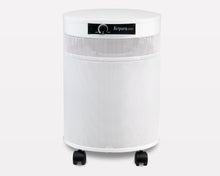
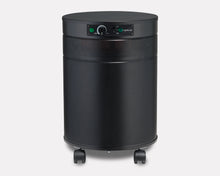
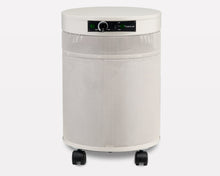
Most "desk purifiers" found in big-box stores are made of thin plastic. These units often vibrate, rattle, and—ironically—can off-gas their own plastic odors when the motor gets warm. Our commercial-grade units feature powder-coated steel or aluminum housings. They are built to take a hit from a vacuum cleaner or a rolling office chair without cracking.
2. Deep-Bed Activated Carbon
If your office smells like the breakroom's burnt popcorn or your neighbor’s cologne, a standard HEPA filter won't help you. HEPA captures particles, but Activated Carbon captures gases and odors. Commercial units use pounds of carbon, whereas residential units often use a thin, carbon-dusted sponge that becomes saturated and useless within weeks.
3. High-Pressure Motors
To move air through dense, high-quality filters, you need a motor with high static pressure. Commercial units use backward-curved impellers that can maintain their CFM rating even as the filter fills with dust. This ensures consistent protection from Monday morning to Friday afternoon.
Specific Requirements for an Office Desk Unit
If you are looking for an air purifier specifically for a desk, you have to balance power with "office etiquette." You don't want a jet engine taking off next to your phone calls, but you don't want a silent unit that isn't actually moving air.
The Decibel (dB) Balance
In an office, noise is a productivity killer. A commercial desk unit should ideally operate between 30 and 50 decibels. At the lower end, it’s a gentle hum (white noise); at the higher end, it’s comparable to a quiet conversation.
Particulate vs. Gas Filtration
For the average desk, you need a "dual-threat" system:
-
Medical Grade HEPA (H13 or H14): This is non-negotiable. It captures 99.97% of particles down to 0.3 microns, including dust, pollen, and bacteria.
-
V-Bank or Deep-Cell Carbon: To handle the VOCs from office equipment and cleaning chemicals.
Solutions & Recommendations: Finding the Right Fit
When selecting a unit for your workstation, consider the specific "pollutant profile" of your office.
-
For Dust and Allergies: If you find yourself sneezing the moment you sit down, prioritize a unit with a large surface area HEPA filter. Look for units that utilize a pre-filter to catch larger lint, which extends the life of the expensive HEPA core.
-
For Odors and Chemicals: If you work near a laboratory, a print shop, or a high-traffic kitchen, you need a "Smoke Eater" style configuration. This involves a heavy carbon canister (sometimes up to 15–20 lbs of carbon) to chemically bond with the odor molecules.
-
For Germs and Viruses: In the post-pandemic era, many offices are looking for UVC Germicidal Lamps. When integrated into a commercial air purifier, UVC light can neutralize the DNA of airborne pathogens as they pass through the filter chamber.
FAQ: Air Purifiers for the Office Desk
Q: Can I just use a small USB-powered air purifier? A: Generally, no. USB-powered units lack the voltage necessary to drive a motor capable of meaningful CFM. They are often "ionizers" that merely charge particles so they stick to your desk surface, rather than actually removing them from the air.
Q: How often do I need to change filters in a commercial unit? A: In a standard office environment, HEPA filters typically last 2–5 years, and carbon filters last 1–2 years. This is significantly longer than residential filters because commercial filters have much more media "surface area."
Q: Will an air purifier on my desk help my coworkers? A: While the primary benefit is for your "personal breathing zone," any air being scrubbed and exhausted back into the room contributes to the overall reduction of the room's total pollutant load.
Q: Is "HEPA-type" the same as HEPA? A: Absolutely not. "HEPA-type" or "HEPA-like" is a marketing term for filters that do not meet the rigorous DOE (Department of Energy) standards. Always insist on True HEPA or Medical Grade H13 filters.
Conclusion: Don't Settle for "Residential" in a Commercial World
Your productivity is tied directly to the air you breathe. Cognitive function drops significantly in environments with high CO2 and VOC levels. By choosing a commercial-grade air purifier for your office desk, you are investing in a machine designed to run longer, breathe deeper, and protect better than any consumer-grade alternative.
Stop breathing in the office "fog." It’s time for an upgrade that actually works.
Ready to clear the air at your workstation? Shop Smoke Eaters and Office Purifiers at commercialairpurifiers.net and take control of your personal environment today.
Ready to improve your air quality? Explore our Office & Workspace Air Purifiers collection, or contact our team for a recommendation tailored to your space.