Commercial Air Purifier Guide: Why Your Business Needs "Overkill" Engineering

Walk into a busy warehouse, a crowded waiting room, or a cigar lounge, and take a deep breath. What do you smell? If the answer is chemicals, dust, or stale smoke, you have a problem that a $150 appliance from a big-box store cannot solve.
We often see business owners try to tackle industrial-grade pollution with residential-grade tools. They buy sleek, plastic towers designed for quiet bedrooms and place them in environments filled with welding fumes or viral aerosols. Inevitably, the motors burn out, the filters clog in days, and the air quality remains hazardous.
At Commercial Air Purifiers, we believe in a simple philosophy: Overkill.
When you are responsible for the health of your employees and the comfort of your customers, "good enough" isn't enough. You need heavy-duty motors, steel housing, and massive filtration capacity. In this guide, we break down exactly what makes a commercial air purifier different, why the physics of airflow dictates your success, and how to choose a machine that actually works.
The Invisible Liability: Why Air Quality Matters
Clean air in a commercial setting is not a luxury; it is an operational necessity. Poor indoor air quality (IAQ) directly impacts your bottom line through employee sick days, reduced cognitive function, and potential compliance violations.
According to the EPA (Environmental Protection Agency), Americans spend approximately 90% of their time indoors, where the concentrations of some pollutants are often 2 to 5 times higher than typical outdoor concentrations. In a commercial building—with higher occupancy density and specific industrial processes—those numbers can skyrocket.
The Cost of "Sick Building Syndrome"
When air quality suffers, so does productivity. OSHA (Occupational Safety and Health Administration) notes that poor IAQ can lead to headaches, fatigue, trouble concentrating, and irritation of the eyes, nose, and throat. This is often referred to as "Sick Building Syndrome."
For a business owner, the risks are threefold:
-
Health: Viral transmission (COVID-19, Flu) and long-term respiratory issues from dust or chemical exposure.
-
Compliance: Meeting standards set by OSHA or industry-specific bodies like the CDC for healthcare.
-
Customer Experience: Nobody wants to eat, shop, or relax in a room that smells like mildew, bleach, or stale smoke.
To solve this, you can't rely on passive ventilation. You need active, aggressive air scrubbing.
The 3 Pillars of Commercial Air Purification
What separates a true commercial air purifier from a residential unit? It comes down to three factors: Airflow (CFM), Filtration Media, and Durability.
1. Airflow: The CFM Rule
This is the most critical metric in the industry. CFM stands for Cubic Feet per Minute. It measures the volume of air the machine pulls through the filter.
A standard residential unit might move 100 to 250 CFM. That is fine for a 12x12 bedroom with the door closed. But in a commercial space, you are fighting a constant influx of contaminants—whether it's a door opening and closing, a printer off-gassing, or a forklift kicking up dust.
To clean a commercial space, you need to turn the air over frequently. This is called Air Changes Per Hour (ACH).
-
Offices: Typically need 4-6 ACH.
-
Warehouses/Industrial: Typically need 6-10 ACH.
-
Smoke Lounges: Need 15-20+ ACH.
If your machine doesn't have the CFM to match the room size, you are trying to empty a swimming pool with a spoon. You need a commercial unit capable of 400, 800, or even 2000+ CFM to stay ahead of the pollution curve.
Stop Guessing: Do not rely on "square footage" estimates on a box. Physics requires precision. Use our CFM Calculator to input your specific room dimensions and ceiling height. It will calculate the exact airflow you need.
2. Filtration Media: Weight Matters
In the world of filtration, size equals capacity.
-
Residential: Thin, panel filters. A few ounces of carbon dust sprayed onto a mesh.
-
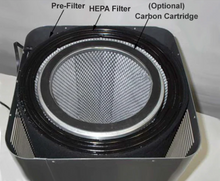
Commercial: Deep-bed HEPA filters that are 6 to 12 inches thick. Canisters containing 15 to 30 pounds of Activated Carbon.
Why does weight matter? If you are trying to remove odors (volatile organic compounds), the carbon acts like a sponge. A sponge the size of a notepad (residential) fills up instantly. A sponge the size of a bucket (commercial) lasts for months or years. Commercial units are designed to hold massive amounts of media so they can run 24/7 without losing efficiency.
3. Durability: Steel vs. Plastic
Commercial environments are tough. Equipment gets bumped by cleaning crews, hit by carts, and exposed to heat or humidity.
-
Residential units are almost exclusively plastic. They yellow over time, crack upon impact, and absorb odors.
-
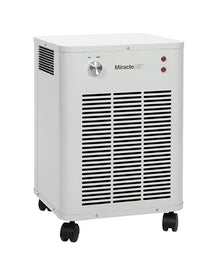
Commercial air purifiers feature powder-coated steel or aluminum housing. They are built to withstand physical abuse and are often modular, meaning you can replace a fan or a switch without scrapping the whole unit.
Selecting the Right Technology for the Pollutant
Not all commercial air purifiers are the same. The "best" unit depends entirely on what you are trying to remove from the air. We classify commercial needs into three main buckets.
The Particulate Fighter (Dust & Debris)
Target: Drywall dust, concrete dust, manufacturing debris, pollen.
Solution: High-Capacity Media Filters.
In warehouses or workshops, the enemy is visible dust. You need a unit with a massive pre-filter and a large main filter bag or pleated element. The goal here is surface area. You want to catch pounds of dirt without choking the airflow.
-
Key Spec: Look for "Media Area" (measured in square feet) and high CFM.
The Infection Controller (Viruses & Bacteria)
Target: COVID-19, Influenza, bacteria, mold spores.
Solution: Medical-Grade HEPA.
For schools, dental offices, and medical clinics, the standard is set by the CDC and ASHRAE. You need HEPA (High-Efficiency Particulate Air) filtration, which captures 99.97% of particles down to 0.3 microns.
-
Key Spec: Ensure the unit is "True HEPA" certified. Avoid "HEPA-type" marketing fluff.
The Odor & Smoke Destroyer (Gases & VOCs)
Target: Cigarette smoke, weld fumes, chemical solvents, kitchen odors.
Solution: Activated Carbon (The "Smoke Eater").
HEPA filters do not stop gas or odors. If you run a cigar lounge or a print shop, a HEPA-only unit will do nothing for the smell. You need Activated Carbon, which adsorbs the gas molecules.
-
Key Spec: Carbon Weight. If it’s not measured in pounds (e.g., "15 lbs Carbon"), it’s not a commercial solution.
Installation Strategies: Floor vs. Ceiling
In commercial settings, floor space is often premium real estate. This is another area where commercial units shine over residential ones.
-
Portable/Floor Units: Great for flexibility. You can roll them to the source of the pollution (e.g., near a specific workstation or in a conference room).
-
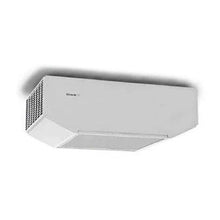
Ceiling-Mounted Units: These are the gold standard for bars, restaurants, and bingo halls. They mount flush or hang from the ceiling, pulling smoke and hot air up (where it naturally wants to go) and redistributing clean air downwards. This creates a "coanda effect," circulating air efficiently without creating drafts that annoy customers.
Frequently Asked Questions
1. How loud are commercial air purifiers?
Commercial units are powerful, and moving air creates sound. However, we engineer our units to balance power with acoustics. At lower speeds, many are appropriate for offices. At high speeds (for warehouses), they generate white noise. We recommend checking the decibel (dB) rating on the spec sheet and comparing it to common sounds (e.g., 50dB is a quiet conversation; 70dB is a vacuum cleaner).
2. Can I just use my HVAC system?
Your HVAC system is designed to control temperature, not to scrub pollutants. While you can upgrade HVAC filters to MERV 13, the system fan isn't designed to push air through dense filters effectively, which can damage your expensive HVAC unit. Standalone commercial purifiers relieve this burden, scrubbing the air independently without restricting your heating or cooling.
3. How do I know what size I need?
It is strictly a math problem. You need to know the cubic footage of the room (Length x Width x Height) and the desired Air Changes Per Hour (ACH). Use our CFM Calculator to get the exact number.
4. How often do commercial filters need to be changed?
This depends on the pollution load. In a heavy smoke environment, carbon filters might need changing every 6–12 months. In a clean office, a HEPA filter can last 2–3 years. Commercial units typically have separate pre-filters; changing these cheaply and frequently (every month or two) significantly extends the life of the main expensive filters.
5. Are commercial air purifiers energy efficient?
Yes. While they use more power than a small residential unit, they are far more efficient per cubic foot of air cleaned. Many of our units use PSC (Permanent Split Capacitor) or EC (Electronically Commutated) motors, which are designed for continuous duty with minimal electricity draw.
The Verdict: Invest in Metal, Not Magic
When you are running a business, you don't have time for gimmicks. You don't need "ionic breezes" or "UV wands" that promise miracles but deliver nothing.
You need physics. You need a steel box, a powerful motor, and a deep filter bed.
Commercial air purifiers are an investment in your infrastructure. They protect your most valuable assets—your people and your customers—and they are built to last for decades, not just through the warranty period.
Ready to equip your business with serious air filtration?
Don't settle for residential toys. Get the "overkill" engineering your facility demands.
[Shop Smoke Eaters at commercialairpurifiers.net]
Ready to improve your air quality? Explore our Air Cleaners & Purifiers collection, or contact our team for a recommendation tailored to your space.