Designing the Perfect Cigar Room: Why You Need a Commercial Air Purifier to Handle the Haze

By the Team at Commercial Air Purifiers
Building a dedicated cigar room is the ultimate dream for the aficionado. Whether it is a converted study, a basement "man cave," or a garage renovation, the goal is always the same: a sanctuary where you can relax, pour a drink, and enjoy a premium stick without worrying about the weather or the neighbors.
But there is a reality that often crashes this dream shortly after the first light: Ventilation.
A cigar is not a cigarette. It burns longer, produces denser smoke, and releases a complex bouquet of oils and tars. If you do not have a robust strategy to handle that output, your sanctuary quickly turns into a suffocation hazard. The "blue haze" drops from the ceiling to eye level, stinging your eyes. The smell permeates the drywall and carpet, turning "aromatic" into "stale." Worst of all, the odor leaks into the rest of the house, leading to conflict with family members who don’t share your hobby.
We see many enthusiasts try to solve this with residential-grade air purifiers they bought online. They invariably fail. Within weeks, the room smells sour, the filters are clogged, and the haze remains.
At Commercial Air Purifiers, we approach smoke with "Overkill" engineering. We know that to maintain a pristine cigar room, you cannot rely on plastic appliances designed for pollen. You need industrial-grade steel, massive carbon beds, and high-velocity airflow. Here is how to choose the right cigar room air purifier and protect your investment.
The Physics of the "Stale" Room
To understand why standard air purifiers fail in cigar rooms, you have to understand the composition of the smoke itself. Cigar smoke is a heavy, two-phase pollutant.
-
The Particulate Phase (The Haze): This is the visible smoke. It consists of fine particles of ash, tar, and combustion byproducts (PM2.5). These particles are sticky. If not removed quickly, they settle on your leather chairs and mahogany humidors, creating a yellow film.
-
The Gas Phase (The Odor): This is the invisible enemy. As tobacco burns, it releases Volatile Organic Compounds (VOCs) like benzene, formaldehyde, and ammonia. According to the Centers for Disease Control and Prevention (CDC), secondhand tobacco smoke contains more than 7,000 chemicals.
The "stale" smell that lingers the next morning is caused by the Gas Phase. A standard HEPA filter captures the dust, but it lets the gas pass right through. To clear a cigar room, you need a system that attacks both phases simultaneously with equal aggression.
Why Residential Units Are Dangerous for Your Room
If you walk into a big-box store, you will see "Smart" air purifiers that claim to handle smoke. In a cigar room, these units are not just ineffective; they can actually become part of the problem.
1. The Plastic Sponge Effect
Residential units are made of injection-molded plastic.
-
The Physics: Cigar smoke contains tar, which is acidic and sticky. Tar bonds to plastic surfaces. Over time, the plastic housing of the air purifier absorbs the tar and the odor.
-
The Result: After a few months of use, the machine itself starts to off-gas a sour, ashtray smell. You can change the filters, but you can’t change the chassis. The unit is ruined.
-
The Commercial Standard: We use powder-coated steel or stainless steel housings. Metal is non-porous. Tar sits on the surface and can be wiped off with a degreaser. A steel unit will never hold odors.
2. The Carbon Deficit
To stop the smell, you need Activated Carbon.
-
Residential Reality: Most home units use a "Carbon Pre-Filter." This is a thin foam sheet with a dusting of carbon. It weighs a few ounces. A single 60-ring gauge cigar can saturate this filter in one session. Once saturated, it stops working.
-
Commercial Reality: To scrub a cigar room effectively, you need weight. You need deep-bed canisters containing 10 to 30 pounds of granular activated carbon. This massive surface area is required to adsorb the heavy VOC load of premium tobacco.
The Airflow Rule: 15-20 ACH
In a normal living room, changing the air 4 times an hour is considered excellent. In a cigar room, that is nowhere near enough. Smoke expands rapidly due to thermal buoyancy. To capture it before it settles into your upholstery, you need speed.
ASHRAE (American Society of Heating, Refrigerating and Air-Conditioning Engineers) guidelines suggest much higher ventilation rates for smoking environments to maintain acceptable indoor air quality.
For a dedicated cigar room air purifier, we recommend a minimum of 15 to 20 Air Changes Per Hour (ACH).
This means the entire volume of air in your room passes through the filter every 3 to 4 minutes.
How to Calculate Your Requirement (CFM):
Ignore the "Square Footage" rating on the box. Those ratings assume 8-foot ceilings and no smoke. You must calculate based on CFM (Cubic Feet per Minute).
The Formula:
$\text{Room Volume (L x W x H)} \times \text{Desired ACH} / 60 = \text{Required CFM}$
Example:
Your cigar room is 12 feet x 15 feet with 9-foot ceilings.
Volume = 1,620 Cubic Feet.
You want 15 Air Changes Per Hour (The Commercial Standard).
$(1,620 \times 15) / 60 = 405 \text{ CFM}$.
You need a unit that delivers at least 405 CFM of actual airflow.
-
The "Overkill" Nuance: A unit rated for 400 CFM might be loud at top speed. We recommend buying a unit rated for 800+ CFM and running it on "Low" or "Medium." This gives you the required airflow in near silence, preserving the relaxing atmosphere of your lounge.
Don't Guess. Use our CFM Calculator. Plug in your room dimensions, and it will tell you exactly how much power is required to keep the air clear.
The Perfect "Stack" for a Cigar Room
When shopping for your unit, look for this specific filtration stack. If a unit is missing one of these stages, it will eventually fail.
Stage 1: The Tar Barrier (Pre-Filter)
This is the bodyguard for the expensive filters. It must be robust enough to catch sticky tar and large ash particles.
-
Commercial Grade: We use metal mesh or fiber pads that can be washed or cheaply replaced. If you let tar hit the main filter, it seals it shut like glue.
Stage 2: Massive Carbon Bed (The Nose)
This is non-negotiable. Look for Granular Activated Carbon.
-
Weight: Look for 15lbs+ of carbon.
-
Chemistry: The best units often mix Potassium Permanganate with the carbon. This acts as an oxidizer, chemically destroying smoke odors rather than just trapping them.
Stage 3: True HEPA (The Eyes)
This captures the fine ash and the blue haze (PM2.5). Ensure it is rated True HEPA (99.97% efficiency at 0.3 microns).
What to AVOID: Ozone Generators
You will see "Ozone Generators" marketed to cigar smokers because they destroy odors instantly.
-
The Danger: Ozone is a lung irritant. The EPA explicitly advises against using ozone generators in occupied spaces. Using ozone while smoking (which is already irritating your lungs) creates a toxic environment. Never use ozone in your cigar room while you are inside.
Installation Strategy: The "Flush Mount" Advantage
Where you place the unit in your cigar room is just as important as the unit itself. Cigar smoke is hot. Physics dictates that hot air rises.
1. The Ceiling Flush Mount
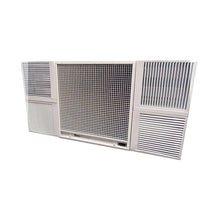
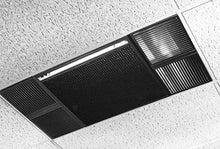
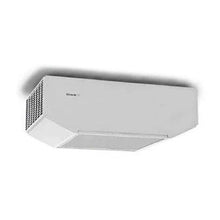
This is the gold standard for cigar rooms. By mounting the unit flush to the ceiling in the center of the room, you work with physics.
-
The Flow: The unit sucks the rising smoke up from the center (where it naturally pools), scrubs it, and pushes clean air out toward the walls. This creates a "shield" of clean air moving down the walls and across the floor, pushing smoke away from your face and into the intake.
-
The Aesthetic: It looks professional, like a high-end lounge, and saves floor space for your humidor and seating.
2. The Floor Mistake
Never place a cigar room air purifier on the floor. If the intake is on the floor, the smoke has to travel up to the ceiling, cool down, and fall back to the floor before the machine can catch it. By then, you have breathed it in, and it has stained your ceiling paint.
-
The Fix: If you cannot mount it to the ceiling, place it on a high shelf or a pedestal. Get the intake as high as possible.
Frequently Asked Questions
Q: Can I just use a window exhaust fan?
A: Exhausting air is effective, but it ruins your climate control. If you suck 500 CFM of air out of the room in winter, you are sucking out all your heat. You have to pay to heat the freezing air coming in to replace it. A recirculating commercial smoke eater cleans the air without losing your heat or AC, saving you massive amounts on energy bills.
Q: How do I handle "Thirdhand Smoke" (smell on walls)?
A: An air purifier prevents thirdhand smoke by capturing the tar before it settles. However, if your cigar room walls are already yellow, the tar has permeated the paint. You need to wash the walls with TSP (Trisodium Phosphate) and repaint. The air purifier will protect the new paint job.
Q: How often do filters need to be changed?
A: In a cigar room, filter life is determined by how many cigars you smoke.
-
Heavy Usage (Daily Smoker): Carbon filters every 4-6 months.
-
Moderate Usage (Weekend Smoker): Carbon filters every 9-12 months.
-
The Test: Trust your nose. If you walk into the room the next morning and it smells stale, the carbon is full.
Conclusion: Respect the Ritual
Your cigar room is an investment in your quality of life. It should be a place of relaxation, not a place where the air quality gives you a headache.
You wouldn't store your cigars in a cardboard box; don't trust your air quality to a plastic appliance. Effective smoke removal requires the brute force of commercial engineering. It demands steel housings that won't absorb odor, massive carbon beds that can hold pounds of VOCs, and industrial motors that can cycle the air 15 times an hour.
Don't let the haze ruin the experience. Validate your airflow needs today with our CFM Calculator. Then, browse our collection of heavy-duty Commercial Smoke Eaters to find the solution that keeps your sanctuary pristine.
References:
-
Centers for Disease Control and Prevention (CDC). "Secondhand Smoke (SHS) Facts."
-
ASHRAE. "Standard 62.1: Ventilation for Acceptable Indoor Air Quality."
-
U.S. Environmental Protection Agency (EPA). "Residential Air Cleaners: A Technical Summary."