The 5th Pillar: Why Air Quality is the Most Overlooked Threat to Your Wine Cellar

By the Team at Commercial Air Purifiers | Published: November 19, 2025
You've spent years, perhaps decades, curating a magnificent wine collection. You’ve invested a small fortune to build the perfect cellar, a sanctuary designed to protect those liquid assets. You’ve obsessed over the "four pillars" of wine preservation: a rock-solid temperature of 55°F, unwavering 60-70% humidity, total darkness, and a vibration-free environment.
Your collection is safe. Or is it?
You walk into your cellar and you smell it. It’s a faint, slightly "damp" odor. Or maybe it’s the sharp, "new" smell of the custom redwood racking you just had installed. You dismiss it. It's just a smell.
As air quality experts who design contamination-control systems for hospitals, labs, and archival facilities, we must tell you: that smell is a critical warning sign. It’s the audible alarm for an invisible threat that is, at this very moment, silently attacking your wine.
Your corks are breathing. And the air they’re breathing is polluted.
Welcome to the fifth pillar of wine preservation: Air Quality. It’s the most misunderstood, most overlooked, and potentially most destructive variable in your entire cellar. And your state-of-the-art cooling unit is doing nothing to stop it.
Why Your Cellar Is a "Perfect Storm" for Air Pollution
A wine cellar is, by its very nature, a "sealed box." To maintain that perfect temperature and humidity, you’ve insulated it, sealed every crack, and installed a heavy, vapor-barrier door. This is great for climate control, but it’s a disaster for air quality.
This design creates a zero-ventilation environment. Every pollutant generated inside your cellar stays inside your cellar, becoming more and more concentrated over time.
The U.S. Environmental Potection Agency (EPA) has consistently found that indoor air concentrations of some pollutants are two to five times higher than outdoor levels. Your sealed cellar is an extreme version of this.
This is a critical problem because a wine cork, as strong as it is, is a porous, natural material. It must "breathe" to allow for the slow, magical aging process. But this slow respiration is a two-way street. Over a span of 5, 10, or 20 years, the air inside your cellar is slowly, but surely, interacting with the wine inside your bottle.
You are facing two distinct, invisible enemies that are leveraging your corks against you.
Enemy #1: The Biological Menace (Mold, Mildew, and TCA)
This is the collector's greatest fear. You’ve intentionally created a cool, damp environment. 60-70% humidity is the target... but it's also the perfect breeding ground for mold and mildew.
According to the EPA, mold can begin to grow on surfaces in as little as 24-48 hours when moisture is present. Once it has a foothold—on a damp wall, a wooden rack, or even a cardboard box—it becomes an active threat.
The "Musty" Smell (mVOCs)
You might see mold as a simple surface stain. But the real threat is what it releases into the air. Mold spores (the "seeds") are physical particles, but the "musty" or "damp" smell itself is a gas, known as a microbial Volatile Organic Compound (mVOC). This gaseous odor is tiny, invasive, and is readily absorbed by your corks, imparting a musty, "cellar floor" taint to your wine.
The "Great Destroyer": Cork Taint (TCA)
This is the "final boss" of wine cellar pollution. That musty smell is a warning shot. The kill shot is TCA (2,4,6-trichloroanisole).
TCA is the chemical that causes "cork taint." It’s the compound responsible for that dreaded, "wet newspaper" or "damp cardboard" aroma that ruins a bottle of wine instantly.
But where does it come from? TCA is not "in" the cork itself. As wine science organizations like the Australian Wine Research Institute have noted, TCA is a "microbial metabolite" that is created when certain airborne molds come into contact with chlorophenols—chemicals that were once common in wood treatments, pesticides, and some cleaning supplies.
Here is the chain of events that can wipe out a collection:
-
Airborne mold spores find a home in your cellar.
-
These molds interact with trace chemicals in the environment (e.g., in your building materials).
-
They create TCA, which becomes an airborne gas.
-
This gaseous TCA is absorbed by your corks, your labels, and the wood of your racks.
-
Your entire cellar is now contaminated. The TCA passes through the cork and into the wine.
The result is devastating. Your $500 bottle of Cabernet is now worthless. And because the contamination is in the air, it’s a threat to every single bottle in your collection.
Enemy #2: The Chemical Threat (VOCs from New Racking, Paint, and Furniture)
This is the "new cellar" problem. You’ve just finished a beautiful renovation. You’ve installed custom redwood or mahogany racking, sealed the concrete floor, and given the walls a fresh coat of paint.
You have, in effect, created a Volatile Organic Compound (VOC) hotbox.
Volatile Organic Compounds (VOCs) are gaseous chemicals that are "off-gassed" (released) from new building materials, paints, stains, and adhesives. The EPA lists these exact items as primary sources of indoor chemical pollution.
-
Paints & Stains: Release formaldehyde, benzene, and toluene.
-
Adhesives & Sealants: The glue in your sub-flooring or the sealant on your concrete.
-
Pressed Wood: Any MDF or particleboard in your cabinetry (which uses formaldehyde-based resins).
-
New Racking: Even natural woods, especially aromatic ones, can release resins and oils with strong odors.
These chemical odors are not just "a smell." They are an invasive gas. Just like the musty mVOCs, these chemical gases will be absorbed by your corks over time, imparting a harsh, "chemical" or "plastic" taint to the wine. This is the very definition of a "fatal flaw" in a cellar's design.
The Archival Solution: A Dual-Filter, Non-Toxic "Trap"
How do you fight an invisible, two-front war? You cannot "mask" these odors. You cannot "clean" them with a simple fan. You must do what professional archivists and museum curators do: you must remove the pollutants from the air.
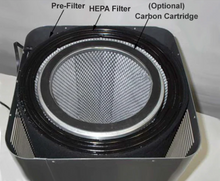
This is a two-part problem. Mold spores are particles. Odors (mVOCs, TCA, and VOCs) are gases. Your HVAC system's filter, if you even have one, cannot stop them. You need a dedicated, professional-grade purification system with two specific, non-toxic tools.
Tool 1: The Particle Shield (A "True" HEPA Filter)
This is your mold spore solution.
You must capture the mold spores before they can land, colonize, and produce TCA. The only technology for this job is a "True" HEPA filter.
HEPA is a medical-grade standard, not a marketing buzzword. It is legally certified to trap and remove 99.97% of all airborne particles down to 0.3 microns. This size is the "gold standard" and is incredibly effective at capturing:
-
All mold and mildew spores
-
All pollen and dust
-
Bacteria and other microorganisms
By constantly "scrubbing" the air with a HEPA filter, you are actively removing the "seeds" of your mold problem. This is a proactive, not a reactive, strategy.
Tool 2: The Gas & Odor Sponge (A Massive Activated Carbon Filter)
This is your TCA, VOC, and musty odor solution.
This is the most critical tool for a wine cellar, and it's where 99% of residential purifiers fail.
A HEPA filter is a net; it cannot stop a gas. The only proven, passive, non-toxic technology to remove gaseous chemicals is activated carbon. It works by a process called adsorption. The carbon is a "gas sponge," with a microscopic, porous structure that has an immense internal surface area. As the air is forced through it, the molecules of TCA, formaldehyde, paint fumes, and musty odors get physically "stuck" and are permanently removed.
Here is the #1 expert insight: A carbon filter's life is based on capacity. The "carbon filter" in a cheap, $150 purifier is a paper-thin sheet dusted with a few ounces of carbon. In a new cellar with high VOCs, it will be 100% saturated (full) in a matter of days or weeks, at which point it becomes useless.
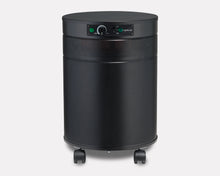
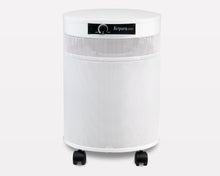
For the high-stakes, 24/7/365 job of protecting a wine collection, you must have a commercial-grade system. Systems with robust, deep-bed activated carbon filters are the only solution. You need a purifier with pounds of carbon, not ounces. We would never recommend a unit for a cellar with less than 15 to 20 pounds of activated carbon. This massive capacity is the only way to ensure it keeps trapping those dangerous gases for months or even years.
The Final Step: How to Size and Place Your System
You’ve found the right tool (HEPA + Carbon). Now you must use it correctly.
1. Power & Sizing (CFM)
Your cellar is a unique space. It's low-traffic but high-stakes. You don't need the 8-10 Air Changes per Hour (ACH) of a smoking lounge. Instead, you need a consistent, continuous scrub. We recommend a target of 2 to 4 ACH. This is enough to turn over the entire volume of air 2-4 times every hour, ensuring spores and gases are removed faster than they can build up.
To find your power target, or CFM (Cubic Feet per Minute), you must do the math.
-
Calculate Your Cellar's Volume:
[Length (ft)] x [Width (ft)] x [Height (ft)]-
Example: A 12ft x 10ft cellar with 8ft ceilings = 960 cubic feet
-
-
Calculate Your Target CFM:
(Volume x ACH) / 60 minutes-
Example: (960 cubic feet x 3 ACH) / 60 = 48 CFM
-
You need a unit that can at least provide 48 CFM. To find the exact, professional recommendation for your cellar's dimensions, use our CFM Calculator.
2. The "Quiet & Still" Secret
Here's the problem: you need power, but your wine hates noise and vibrations. A cheap, plastic-bodied purifier running on "High" will vibrate and be loud.
This is the ultimate pro-tip: You oversize your purifier.
Don't buy a unit with a max of 50 CFM. Buy a high-quality, 300-CFM unit that is built with a steel housing and a balanced, commercial-grade motor. Why? Because you can run it on its "Low," 100-CFM setting.
-
It will be whisper-quiet (often under 35 dB).
-
It will be vibration-free.
-
It will still be doubling your 48 CFM target, providing archival-level air quality without disturbing your collection.
3. Placement
Do not shove your purifier in a cramped corner or behind a rack. This "chokes" the intake and makes the motor work harder, creating noise and reducing effectiveness. Place it in a central location with at least 2-3 feet of clearance, allowing it to create a gentle, circular airflow that scrubs the entire room.
Conclusion: The 5th Pillar Is Your Collection's Insurance Policy
You've spent a lifetime building your collection. You've perfected the four pillars of temperature, humidity, darkness, and stillness. But you've left the "front door" wide open for the invisible, airborne threats of mold, TCA, and VOCs.
Air quality is the 5th Pillar. It's the final, crucial step to creating a true archival-grade sanctuary.
An investment in a professional air purification system—one with a True HEPA filter for the spores and a massive, multi-pound carbon filter for the gases—is not an "expense." It’s the single most important insurance policy you can buy to protect your passion and your investment for the decades to come.
Ready to add the 5th pillar of protection to your cellar? Explore our full collection of High-Performance Air Purifiers designed for the toughest chemical and particle loads.
Frequently Asked Questions (FAQ)
Q: Can I just use an ozone generator to kill the musty smell?
A: Absolutely not. We strongly advise against this. Ozone is a highly reactive, toxic gas. The EPA warns that it is a powerful lung irritant that is unsafe for occupied spaces. More importantly for your wine, as a powerful oxidant, it can damage organic materials over time, potentially harming your corks, labels, and even the wine itself. It is a "brute force" tool that is far too dangerous for a sensitive collection. A passive, non-toxic carbon filter is the only safe and effective solution.
Q: My wine cellar is part of a new construction home. What should I do?
A: This is a critical time. Your new cellar is saturated with VOCs from paint, sealant, and new racking. You must "scrub" this air before you move your wine in. We recommend installing your HEPA/carbon purifier and running it on HIGH for at least 1-2 weeks to rapidly adsorb the worst of the off-gassing. Then, you can add your collection and turn the unit down to its quiet, long-term "maintenance" speed.
Q: Will the air purifier's motor or fan vibrate my wine?
A: This is a valid concern. A cheap, plastic-bodied residential purifier can create a high-frequency vibration. This is why we recommend commercial-grade units, which are built with heavy-gauge steel housings and high-quality, balanced EC motors. These are designed for vibration-free, silent operation.
QS: My cellar has a cooling unit. Doesn't that filter the air?
A: No. The filter on your cooling unit is just like the filter on your HVAC—it's a simple, low-grade (MERV 4 or 8) filter designed only to protect the cooling coils from large dust. It has zero effect on fine mold spores, and zero effect on gaseous VOCs, TCA, or odors. It is not an air purifier.
Ready to improve your air quality? Explore our Air Cleaners & Purifiers collection, or contact our team for a recommendation tailored to your space.