The Best Air Purifier to Remove Cigarette Smoke? Stop Buying Toys.

TL;DR: Cigarette smoke defeats almost every consumer air purifier because it's three problems at once — fine particulate (PM2.5), odor-causing gases (VOCs), and sticky tar that ruins filters and motors. The only thing that actually removes it is commercial-grade engineering: a steel housing, a heavy metal-mesh pre-filter to catch tar, pounds (not ounces) of activated carbon for the smell, True HEPA for the particles, and enough CFM to change the room's air 10–20 times an hour. If a purifier weighs ten pounds and runs silent, it's a toy. If it weighs fifty because it's full of steel and carbon, it's a tool.
Cigarette smoke is the litmus test of air purification. Plenty of machines can handle a little dust; almost none can handle the relentless, sticky, chemical-laden assault of tobacco smoke. If you've ever bought a big-box purifier, run it on "turbo," and still watched the room turn stale and the walls go yellow — while the purifier itself started giving off a sour, tar-like smell — you've met the problem firsthand. Most units sold as "smoke air purifiers" are wildly under-engineered for the job. It's like trying to put out a campfire with a spray bottle.
At Commercial Air Purifiers we believe in "overkill" engineering: heavy steel, industrial torque, and massive beds of activated carbon. This guide explains exactly why cigarette (and vape) smoke beats standard filters, the specs a purifier must have to actually clear it, how to size and place the unit, and what we recommend.
The Anatomy of the Haze: Why Smoke Defeats Standard Filters
Cigarette smoke is a three-headed monster, and a purifier has to beat all three heads at once:
- Particulates (the visible cloud): fine ash and combustion byproducts, dominated by PM2.5 — particles small enough to lodge deep in the lungs.
- Volatile Organic Compounds (the invisible odor): gases like benzene, formaldehyde, and ammonia. This is the smell, and it's a gas — you cannot catch a gas in a particle filter.
- Tar (the sticky binder): the machine-killer. Wet tar hardens into a sticky yellow film that seals filter fibers like glue and, in cheap units, coats motor windings.
According to the CDC, secondhand smoke contains more than 7,000 chemicals, hundreds of which are toxic and at least 69 of which are known to cause cancer. A True HEPA filter alone catches the ash but lets the gas pass straight through — and the tar destroys the expensive HEPA media in weeks. That's why a single-filter approach fails.
Why Consumer Units Fail
The failure isn't bad luck; it's physics and materials:
- Plastic housings absorb odor. Plastic is porous. In a smoking environment it soaks up tar and nicotine until the purifier itself smells like an ashtray. Wiping it down doesn't help — the smell is in the plastic.
- A "carbon filter" that's really a foam sheet. Most residential "carbon pre-filters" are a thin black foam mat with a dusting of carbon — a few ounces at most. Against a pack-a-day habit it saturates in days, and saturated carbon can even start re-releasing the odors it captured.
- No tar barrier. Without a substantial pre-filter, wet tar goes straight onto the HEPA media and glues it shut.
- Motor burnout. In cheap units with open-frame motors, tar coats the copper windings, causing heat buildup and eventual motor failure. Commercial units use sealed or industrial-rated motors built to survive harsh environments.
- Ionic units have no airflow. Filterless "ionic" purifiers have essentially zero suction and are overwhelmed instantly by real smoke. You need a fan-driven mechanical system.
The Three Commercial Features a Cigarette-Smoke Purifier Must Have
1. A Steel Housing (No Plastic)
The best units use powder-coated or stainless steel. Steel is non-porous — tar wipes off with a degreaser and the machine never becomes a source of odor itself. A steel unit can run for decades in a smoking environment without retaining smell.
2. Pounds of Carbon (Not Ounces)
Killing the smell requires adsorption — gas molecules bonding to the vast internal surface area of activated carbon. The commercial standard is deep-bed canisters holding 15 to 30 pounds of granular activated carbon (heavy bars and lounges often run 20–30+ pounds; some purpose-built units carry even more). The best beds are often impregnated with an oxidizer such as potassium permanganate or potassium iodide, which chemically destroys smoke odor molecules rather than just trapping them. A rule of thumb: if the manufacturer won't list the carbon weight, assume it's negligible.
3. A Tar Barrier (Pre-Filtration)
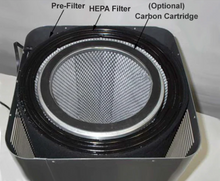
Before the air reaches the carbon and HEPA, it has to pass through a substantial pre-filter — typically a metal mesh or oil-mist pad (roughly MERV 8–10 class) that captures the wet, sticky tar. This is what protects the expensive downstream media. In a well-designed stack the HEPA sits after the pre-filter and carbon, so it only ever scrubs clean, dry air.
The Perfect Filter Stack
- Stage 1 – Pre-filter (the tar barrier): metal mesh / oil-mist pad to trap tar and large particles.
- Stage 2 – Deep-bed activated carbon (the nose): 15+ lbs to adsorb VOCs and odor.
- Stage 3 – True HEPA (the eyes): captures 99.97% of particles at 0.3 microns — the visible haze and PM2.5.
The Physics of Airflow: Speed Is Everything
Filtration media only matters if the machine moves enough air through it. The metric is CFM (Cubic Feet per Minute), and ASHRAE ventilation principles tell us how much you need. Air changes per hour (ACH) is the target:
- Standard room: 4–6 ACH.
- Active smoking environment: 10–20 ACH — meaning the room's entire air volume passes through the filter every 3 to 6 minutes. (For a lighter-use home room, 4–6 ACH; for a busy bar or lounge, 6–10+ ACH is a practical floor.)
The formula is simple:
Room Volume (L × W × H) × Desired ACH ÷ 60 = Required CFM
Example: a room 12 × 15 with 8-foot ceilings is 1,440 cubic feet. Targeting 15 ACH for high performance: (1,440 × 15) ÷ 60 = 360 CFM. You need a unit that delivers at least 360 CFM.
Here's the "overkill" nuance: a residential unit might only hit 360 CFM screaming on turbo, where it's loud and short-lived. A commercial unit rated for 800 CFM delivers that same 360 CFM running on low — quieter, cooler, and for years. Ignore the "square footage" number on the box; it usually assumes 8-foot ceilings and no smoke.
Don't guess. Use our CFM Calculator — enter your room dimensions and it returns the exact airflow you need.
What About Vape Smoke?
Vape aerosol is not "harmless water vapor." Per the U.S. Surgeon General it carries ultrafine particles, and e-liquids can release flavoring chemicals like diacetyl (linked to the severe lung disease known as "popcorn lung"), heavy metals such as nickel, tin, and lead leached from heating coils, and irritants like formaldehyde and acrolein formed when the liquid is heated — plus nicotine. The filtration answer is the same as for cigarettes, tuned for gases: a large volume (15–25 lbs) of activated carbon is critical for adsorbing nicotine, propylene glycol, vegetable glycerin, and flavoring chemicals, backed by True HEPA and high CFM. Vape shops and lounges are exactly the "heavy use" scenario these commercial units are built for.
Consumer Toy vs. Commercial Tool
| Feature | Big-box "smoke" purifier | Commercial smoke eater |
|---|---|---|
| Housing | Porous plastic (absorbs odor) | Powder-coated / stainless steel |
| Carbon | A few ounces on a foam sheet | 15–30+ lbs deep-bed granular carbon |
| Tar handling | None — tar clogs the HEPA | Metal-mesh / oil-mist pre-filter |
| Motor | Open-frame; tar causes burnout | Sealed / industrial-rated for 24/7 |
| Airflow | ~360 CFM only on "turbo" | 800+ CFM, delivers target on low |
| Lifespan in smoke | Months | Years to decades |
Technologies to Avoid: The Ozone Trap
Ozone generators are aggressively marketed to smokers as a filterless "odor destroyer." Ozone is a powerful lung irritant, and the EPA explicitly advises against using ozone generators in occupied spaces — they can trigger asthma attacks and respiratory distress. Never run an ozone generator in a room where people are present or smoking. Stick to mechanical filtration (carbon + HEPA). If you do consider a unit with a supplemental ionization stage, make sure it's certified to meet strict ozone-emission limits (for example, California Air Resources Board certification) and that the stage can be switched off.
Installation Strategy: Controlling the Plume
1. Ceiling Mount Is King
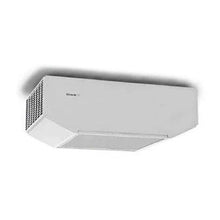
In bars, lounges, bingo halls, and cigar rooms, the most effective placement is a ceiling-mounted smoke eater flush to the ceiling near the center of the room. Smoke rises; a ceiling unit intercepts it at the top and creates a toroidal (donut-shaped) circulation pattern that pulls a continuous shield of clean air across the room.
2. Avoid the Floor Mistake
Never sit a smoke unit on the floor. Smoke has to rise, cool, and fall before a low intake can capture it, so a floor unit is always working against the room. If you can't ceiling-mount, put the unit on a high shelf, stand, or pedestal with the intake at chest or head height.
What We Recommend
Match the equipment to the space:
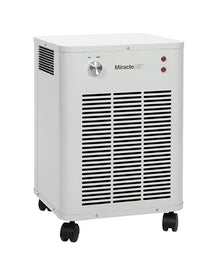
- Bars, lounges, cigar rooms, vape shops: a ceiling-mounted commercial smoke eater with a heavy carbon bed and industrial motor. This is the category our American-made commercial smoke eaters (Smokemaster, LakeAir, and MiracleAir) are built for — steel construction, deep carbon, and the CFM to hold 6–20 ACH in a working room.
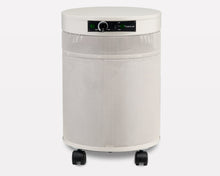
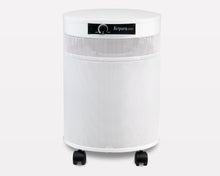
- Homes, offices, and single rooms with heavy residue: a portable heavy-carbon unit. Airpura's dedicated tobacco/smoke and chemical models (the T-series, including the deep-carbon "DLX" configurations) are purpose-built to adsorb nicotine and VOCs and are a strong fit here.
Whatever you choose, judge it by the three specs above — steel, pounds of carbon, and CFM — not by the marketing on the box.
Frequently Asked Questions
How often do I change filters for a pack-a-day smoker? Check the pre-filter monthly (weekly to bi-weekly in a busy bar). Replace carbon every 3–6 months — trust your nose; when the odor returns, it's saturated. Replace True HEPA every 6–12 months (1–3 years in lighter use).
Can a purifier fix thirdhand smoke and yellow walls? A purifier prevents new residue by pulling smoke out of the air before it settles. Existing yellowed walls need washing or repainting — then the purifier protects the fresh paint.
Why not just use a window exhaust fan? Exhausting 500 CFM out a window in winter throws away your heated (or cooled) air. A recirculating commercial smoke eater cleans the air without losing climate control.
Can I use an ionic (filterless) purifier for smoke? No. Ionic units have no meaningful airflow and are overwhelmed instantly. You need a fan-driven mechanical system with carbon and HEPA.
Does it help if my neighbor's smoke drifts in? Yes — run a heavy-carbon unit 24/7, positioned near the entry point (the shared vent, wall, or door) where the smoke leaks in. Sealing that pathway helps too.
Conclusion: Invest in Infrastructure, Not Appliances
The best air purifier for cigarette smoke isn't the sleek plastic tower — it's the one that weighs fifty pounds because it's full of steel and carbon. A steel body, a sealed motor, a tar barrier, deep-bed carbon, and True HEPA, moving enough air to change the room 10–20 times an hour: that's what actually removes smoke and odor for good. Size your room with our CFM Calculator, then browse our commercial smoke eaters and get a machine built for the job.