The Clean Job Site: Why Commercial Air Purifiers Are a Contractor's Best Tool for Safety and Referrals

By the Team at Commercial Air Purifiers Published: December 4, 2025
In the world of contracting, remodeling, and restoration, your reputation is often built on the last 10% of the job. You can execute perfect framing, flawless drywall, and exquisite trim work, but if the client comes home to find a layer of white dust coating their antique grand piano or sees their child coughing in the next room, that is what they will remember.
For years, "dust control" meant taping up some plastic sheeting and hoping for the best. But as homeowners become more educated about indoor air quality (IAQ) and regulations regarding worksite safety tighten, the standard has shifted. The difference between a "good" contractor and a "premium" contractor is often how they manage the invisible byproduct of their work: the air.
At Commercial Air Purifiers, we work daily with general contractors, restoration specialists, and tradespeople who have realized that air quality isn't just a health and safety box to check—it is a competitive advantage. Using a dedicated commercial air purifier (often called an "air scrubber" in the trade) transforms a chaotic, dusty worksite into a controlled, professional environment.
But not all machines are created equal. A residential unit from a big-box store will choke on drywall dust in minutes. To handle the rigors of a job site, you need equipment engineered for high-impact filtration and aggressive airflow.
The Invisible Hazard: It’s Not Just "Dust"
Before we discuss the hardware, we need to understand the enemy. On a construction site, "dust" is a misleadingly simple term for a complex mixture of hazardous materials.
When you sand drywall, cut concrete, or disturb old insulation, you aren't just making a mess; you are aerosolizing particulates that can linger for hours.
-
Respirable Crystalline Silica: This is the big one. Found in concrete, brick, mortar, and stone, silica dust is classified as a human lung carcinogen. The Occupational Safety and Health Administration (OSHA) has enforced strict permissible exposure limits (PEL) for respirable crystalline silica. Breathing this in causes silicosis, an incurable lung disease.
-
Lead and Asbestos: In homes built before 1978, sanding paint or disturbing pipe wrap can release neurotoxins and carcinogens. Under the EPA’s RRP (Renovation, Repair, and Painting) Rule, contractors must contain this dust.
-
Mold Spores: For restoration contractors, disturbing a water-damaged wall without air filtration is practically malpractice. It spreads the colony to the rest of the building.
-
VOCs: Paints, varnishes, and adhesives release Volatile Organic Compounds. These fumes can cause headaches and dizziness for your crew and the homeowners.
A standard shop vacuum handles the pile on the floor, but it does nothing for the cloud in the air. In fact, many standard vacuums actually blow the finest, most dangerous particles back into the room through their exhaust ports.
The Mechanism of Control: Scrubbing vs. Negative Air
When selecting a commercial air purifier for contractors, you are generally looking for a machine that can perform two distinct functions: Air Scrubbing and Negative Air Pressure. Understanding the difference is vital for effective containment.
1. Air Scrubbing (Recirculation)
In this setup, the unit sits in the middle of the room. It pulls dirty air in, filters it, and exhausts clean air back into the same space.
-
The Goal: To drastically reduce the particle count in the workspace.
-
The Application: Drywall sanding, light demolition, or painting in a sealed room. It acts as a kidney for the room, constantly cycling the air to remove impurities.
2. Negative Air Pressure (Containment)
This is the gold standard for renovation work in occupied homes. You attach a duct to the exhaust side of the unit and run that duct out a window or into a different zone.
-
The Goal: To lower the air pressure inside the work zone relative to the rest of the house.
-
The Physics: Air always flows from high pressure to low pressure. By blowing air out of the work zone, you create a vacuum effect. Clean air from the hallway is pulled into the work zone through any gaps in your plastic barriers. This ensures that no dust can escape the work zone to contaminate the rest of the house.
-
The Requirement: This requires a machine with a sealed motor and high static pressure capability—features rarely found in residential units.
Understanding CFM: The Horsepower of Air Filtration
In the residential market, you might see air purifiers rated by "square footage." In the commercial and contractor space, that metric is useless because the ceiling heights and contamination levels vary wildly. Instead, we use CFM (Cubic Feet per Minute).
CFM measures the volume of air the machine moves. To maintain a safe worksite, you need a much higher exchange rate than a typical living room.
-
Residential standard: 2 to 4 Air Changes Per Hour (ACH).
-
Construction standard: 6 to 12 Air Changes Per Hour (ACH).
If you are demoing a bathroom that is 10x10x8 feet (800 cubic feet), and you want 10 air changes per hour (a complete scrub every 6 minutes), you need a machine that can handle that load while the filter is loading up with dust.
Don't Guess—Calculate Undersizing your unit means the dust cloud hangs in the air longer than it should. Oversizing is inefficient. To get the right number, you should plug your specific job site dimensions into our CFM Calculator . This tool helps you determine exactly how much airflow is required to achieve the necessary Air Changes Per Hour for effective containment.
The Hardware: What Makes a Unit "Commercial Grade"?
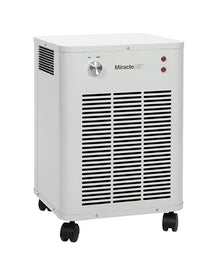
We are often asked, "Can't I just buy three cheap units from a department store?" The answer is a hard no. Here is why commercial air purifiers (often referred to as air scrubbers) are engineered differently.
1. Roto-Molded Housings
A contractor's tools live a hard life. They bounce around in the back of a van, get kicked, and get stacked. Commercial units are typically encased in rotationally molded polyethylene. This is the same tough plastic used to make whitewater kayaks. It won’t crack if you drop a hammer on it, and it won’t dent like metal.
2. The Filtration Stack
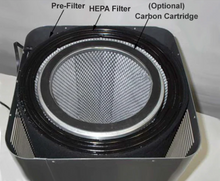
A commercial unit isn't just a fan with a filter. It uses a progressive filtration stack to protect the expensive components.
-
Pre-Filters: These are cheap, disposable pads that catch the "boulders"—sawdust, drywall chunks, and pet hair. You change these daily or weekly to keep airflow high.
-
Carbon Filters: Essential for painters and flooring specialists. Systems with robust activated carbon filters are designed to adsorb the VOCs from epoxy, polyurethane, and paint thinner, preventing the "chemical smell" from traveling upstairs to the client.
-
True HEPA: The final stage must be a True HEPA filter, capable of trapping 99.97% of particles at 0.3 microns. This is what catches the silica and mold spores.
For a deeper look at how these filters function in heavy-duty environments, you can read our guide on commercial air scrubbers .
3. Sealed Motors and Electronics
Fine dust is a killer of electronics. It gets into motor windings and causes overheating. Commercial units feature sealed motors and shielded switches designed to operate in environments where the air is thick with particulates.
The Marketing Angle: Selling "Clean" to Your Clients
Beyond the health benefits and OSHA compliance, owning a fleet of commercial air purifiers is a massive marketing asset.
Imagine the sales conversation:
-
Competitor: "We'll hang some plastic and try to keep the dust down."
-
You: "We use hospital-grade air scrubbers to create negative pressure in the work zone. This ensures that dust, dangerous silica, and paint fumes are actively removed from your home, keeping your family safe and your furniture clean."
This approach builds immense trust. It signals that you respect their property and their health. It justifies a higher price point because you are providing a premium service.
Technical Considerations for the Job Site
When setting up your air quality plan, keep these technical details in mind to maximize efficiency.
Placement Matters Do not just shove the unit in a corner. In a scrubbing configuration, place the unit in the center of the room or opposite the area generating the most dust. This creates a circular airflow pattern. If setting up negative air, place the unit near the window or door you are venting through to keep the duct run short and straight.
Monitor the Pressure As the pre-filter loads with dust, the CFM will drop. Commercial units often have a pressure gauge (manometer). When the pressure differential drops below a certain point, it is time to change the pre-filter. Ignoring this will starve the motor and reduce containment.
Daisy-Chaining On large commercial sites or whole-home renovations, one unit might not be enough. Many commercial air purifiers feature onboard GFCI outlets, allowing you to "daisy-chain" multiple units together on a single 15-amp circuit. This allows you to distribute airflow across a large basement or hallway without running extension cords everywhere.
Frequently Asked Questions
Q: Do I really need a HEPA filter for drywall dust? A: Yes. While drywall dust looks like large white powder, a significant portion of it breaks down into microscopic particles that can bypass standard filters and lodge deep in the lungs. Furthermore, if you are working in an older home, you cannot guarantee that the drywall compound doesn't contain trace asbestos or lead. HEPA is the only safe bet.
Q: How often should I change the HEPA filter in a commercial unit? A: Unlike the pre-filters which are changed often, the main HEPA filter in a commercial unit can last 3 to 6 months (or even a year) depending on usage, provided you change the pre-filters regularly. The pre-filter is the bodyguard for the expensive HEPA filter.
Q: Is "Air Scrubber" different from "Air Purifier"? A: In terms of technology, no—they both move air through filters. However, in industry speak, an "Air Scrubber" refers to a rugged, portable commercial unit designed to be ducted and moved from job to job, whereas an "Air Purifier" often implies a stationary residential unit. For contractors, you want an Air Scrubber.
Q: Can I use these units for water damage restoration? A: Absolutely. In fact, air movement is critical for drying. However, for mold remediation, you must use a unit with a verified sealed housing to prevent spores from bypassing the filter. Check out our resources on mold remediation and air quality for specific protocols.
Conclusion: Professional Grade Tools for Professional Results
You wouldn't frame a house with a plastic toy hammer, and you shouldn't try to control job site air quality with a flimsy residential fan. The modern construction environment demands equipment that is durable, powerful, and compliant with safety standards.
By integrating commercial air purifiers into your workflow, you protect your crew from long-term respiratory issues, you protect your clients from the intrusion of construction byproducts, and you protect your business from liability.
A clean job site is a sign of a disciplined contractor. If you are ready to upgrade your fleet and stop fighting the dust cloud, the first step is knowing exactly what power you need. Use our CFM Calculator to size your next job, or browse our selection of equipment designed specifically for the trades.
References:
-
Occupational Safety and Health Administration (OSHA). "Respirable Crystalline Silica Standard for Construction (29 CFR 1926.1153)."
-
U.S. Environmental Protection Agency (EPA). "Lead Renovation, Repair and Painting Program Rules."
-
Centers for Disease Control and Prevention (CDC) / NIOSH. "Control of Hazardous Dust During Concrete Renovation."
Ready to improve your air quality? Explore our Manufacturing & Dust Removal collection, or contact our team for a recommendation tailored to your space.