Containing the Cloud: Your Comprehensive Guide to a Negative Pressure Smoking Room

By the Team at Commercial Air Purifiers
TL;DR: The only reliable way to keep smoke from migrating out of a smoking room is negative air pressure: mechanically exhaust more air from the room than is supplied, so air always flows into the room instead of out. Getting there takes three things — a properly sized exhaust ducted outdoors, a well-sealed room (door, outlets, HVAC vents), and a controlled source of makeup air. Pair that with an in-room HEPA + activated carbon air purifier to protect the people inside the room and reduce thirdhand smoke buildup. Signs, towels under the door, and air fresheners do not work.
You’ve designated a smoking area, but the faint, unmistakable scent of cigarette smoke still manages to wander down hallways, seep under doorways, and generate complaints from employees, tenants, or guests. It’s a frustratingly common problem — and one customers ask us about constantly, whether they manage a commercial facility or simply want to enjoy a cigar at home without the rest of the household knowing about it.
The issue isn't just the odor; it's the complex mixture of harmful chemicals and particulate matter that escapes and contaminates surrounding areas. You’ve likely tried the conventional wisdom — a towel stuffed under the door, an open window, a flurry of air freshener — only to find these methods frustratingly ineffective. They fail because they don’t address the fundamental physics of how air moves through a building. This guide walks you through the science and practical application of creating a negative pressure smoking room — the gold standard for smoke containment used in professional settings like hospitals and laboratories — and explains why pairing this strategy with the right air purification is the key to a truly comprehensive solution.
The Lingering Problem: When Designated Smoking Areas Fail
The health risks associated with secondhand smoke are not up for debate. According to the Centers for Disease Control and Prevention (CDC), secondhand smoke contains more than 7,000 chemicals, of which hundreds are toxic and about 70 can cause cancer. There is no risk-free level of exposure. When a smoking lounge or room is improperly sealed or ventilated, it actively exposes non-smokers in the building to these dangers, undermining the very purpose of its creation.
Beyond secondhand smoke, there's the insidious problem of thirdhand smoke — the residue from tobacco smoke that clings to walls, carpets, furniture, and ventilation ducts long after a cigarette has been extinguished. These toxic particles can re-enter the air and be inhaled, and research shows the residue can react with other indoor pollutants to form new, harmful compounds over time.
Here’s why smoke is such a masterful escape artist: a room is not an airtight vault. It’s a leaky container with countless invisible paths for air to travel — tiny gaps in baseboards, around window frames, through electrical outlets, and most significantly, under and around the door. Air is a fluid; it moves through the smallest cracks, driven by subtle differences in temperature and pressure, and it always follows the path of least resistance. The gaseous chemicals (VOCs) that carry the odor are microscopic, and they will follow every available path of airflow. Without a system designed to control that airflow, you are essentially hoping the smoke decides to stay put. Simply putting a sign on a door doesn’t create a barrier against microscopic threats — physics and engineering do.
The Core Concept: What Is a Negative Pressure Room?
A negative pressure room is an isolation technique used to contain airborne contaminants, whether in a hospital protecting against infectious diseases or in a commercial building controlling tobacco smoke.
The principle is surprisingly simple: more air is mechanically exhausted from the room than is supplied to it.
Imagine a box with a fan pushing air out and only a small opening for air to come in. The fan creates a lower-pressure environment inside the box compared to the surrounding area. Because air naturally flows from higher pressure to lower pressure, air from outside the box is continuously pulled into the box through the opening.
In a smoking room, this means that even when the door is opened, air from the hallway rushes in, preventing the smoke-filled air inside from escaping. This constant inward flow forms an invisible barrier the smoke molecules cannot cross — containment is the single most critical function of a negative pressure system. It directs the flow of air so that all contaminants generated within the room are captured and exhausted directly outside, rather than migrating throughout the building.
How Common "Fixes" Compare
| Approach | What It Actually Does | Does It Contain Smoke? |
|---|---|---|
| Towel under the door | Blocks one gap while smoke exits through outlets, vents, and trim gaps | No |
| Air freshener / sprays | Masks odor temporarily; removes nothing from the air | No |
| Opening a window in the smoking room | Creates unpredictable airflow — wind and HVAC dynamics can just as easily push smoke into the rest of the building | Unreliable |
| Air purifier alone | Cleans in-room air but does nothing to control pressure or airflow direction | Partial |
| Negative pressure system + in-room purification | Guarantees one-way inward airflow, exhausts contaminants outdoors, and scrubs the air inside the room | Yes |
The Three Pillars of an Effective Negative Pressure System
Creating this pressure differential isn't as simple as installing an exhaust fan and calling it a day. It requires a balanced system built on three essential components:
A Dedicated and Powerful Exhaust System: This is the engine of the operation. The exhaust fan must be powerful enough to remove a specific volume of air from the room, measured in Cubic Feet per Minute (CFM). The required CFM depends on the size of the room and the desired number of air changes per hour (ACH). Industry standards, such as those from ASHRAE (American Society of Heating, Refrigerating and Air-Conditioning Engineers), often recommend high ACH rates for smoking lounges — frequently 15 to 30 or more — to ensure contaminants are diluted and removed quickly. The exhaust must be ducted directly to the exterior of the building, away from any air intakes or public spaces.
Airtight Room Construction: For negative pressure to be maintained, the room must be sealed as tightly as possible. Any leaks compromise the system, allowing contaminated air to escape and clean air to enter from unintended places. This means sealing all penetrations in the walls, ceiling, and floor — around light fixtures, electrical outlets, and plumbing. The door is the primary point of leakage and should be fitted with high-quality gaskets and a door sweep.
A Controlled Source of Makeup Air: Since you're constantly exhausting air from the room, you need to replace it. Without a planned source for this "makeup air," the exhaust fan will pull it from wherever it can — through cracks in walls, from the ceiling plenum, or from other undesirable places. This can starve the room of air, strain the fan motor, stall the airflow, and potentially cause backdrafts in other building systems. The best practice is to provide a transfer grille or an undercut in the door, allowing clean, conditioned air from the adjacent hallway to serve as makeup air and reinforce the desired inward flow.
Sealing the Room: A Practical Walkthrough
Whether you’re building out a commercial lounge or converting a spare room at home, the sealing work is the foundation that lets your exhaust system do its job. Here’s where we recommend focusing your effort.
The Door: Your Primary Line of Defense
The largest and most obvious leak in any room is the door. A standard hollow-core interior door offers very little resistance to air and odor.
Weatherstripping: Apply high-quality, adhesive-backed foam or rubber weatherstripping around the top and sides of the doorjamb so the door forms a firm seal when closed.
Door sweep: Install a heavy-duty door sweep with a flexible rubber seal at the bottom of the door, adjusted to press firmly against the threshold. (If your design uses the door undercut as the planned makeup-air path, leave it — the point is to eliminate unplanned leaks, not the one intentional inlet.)
The Leaks You Don't See
Electrical outlets and switches: These are essentially holes in your wall. Remove the cover plates and install inexpensive foam gaskets — available at any hardware store — to seal them.
Gaps and cracks: Use a flexible, paintable caulk to seal visible gaps between the baseboards and the floor, and around window frames and trim.
Dealing with Shared HVAC Vents
This is a critical, non-negotiable step. If the room has supply or return vents connected to a central HVAC system that serves other spaces, those ducts are direct highways for smoke to the rest of the building. In a residential setup, they must be sealed: magnetic vent covers are an excellent non-permanent solution for renters, while homeowners can close the duct damper and seal the vent cover edges. In commercial construction, codes typically require the smoking room’s exhaust to be fully independent, with no recirculation into non-smoking areas — a qualified HVAC professional should verify this.
Sizing the Exhaust and Providing Makeup Air
Your exhaust fan needs to be powerful enough to overcome the other pressure dynamics in the building. For a residential containment setup, a practical target is 10 air changes per hour (ACH); commercial smoking lounges are typically designed to much higher rates per ASHRAE guidance and local code. To calculate the CFM your fan needs:
CFM = (Room Volume in Cubic Feet × Target ACH) ÷ 60 minutes
In a commercial build, the exhaust is a ducted, permanently installed system. For a non-permanent, apartment-friendly setup, a high-quality window fan designed for exhaust is the best tool — choose a twin-blade or reversible model that fits snugly into the window frame to create a good seal.
Makeup air deserves equal attention. Do not simply open another window in the same room — that short-circuits the airflow. In a home setup, crack open a window an inch or two in a room far away from the smoking room. Your exhaust fan will then pull fresh air from that distant window, through the home, under the sealed door of your smoking room, and out the exhaust — creating the perfect inward-flowing barrier. In a commercial design, the transfer grille or door undercut serves the same purpose in a more controlled way.
Why Ventilation Alone Is Not a Complete Solution
A properly designed negative pressure system is masterful at containing and exhausting airborne contaminants, but it has limitations. Ventilation works by dilution and removal — constantly replacing contaminated indoor air — but it doesn't instantly eliminate 100% of the smoke particles and gases generated within the room.
Tobacco smoke is a complex aerosol of solid particles (tar and soot) and a vast array of gases (like carbon monoxide and formaldehyde). While the exhaust fan is removing this mixture, people inside the room are still exposed to high concentrations. The stickier particles and vapors can also settle onto surfaces before they're exhausted, contributing to thirdhand smoke buildup.
This is where in-room air purification becomes the crucial second layer of defense. By capturing contaminants at the source, a high-performance air purifier reduces the load on the ventilation system, lowers the pollutant concentration for occupants, and helps mitigate residue accumulation on surfaces. The U.S. Environmental Protection Agency (EPA) notes that filtration is an effective supplement to source control and ventilation for improving indoor air quality.
The Integrated Solution: Negative Pressure Plus High-Efficiency Air Purification
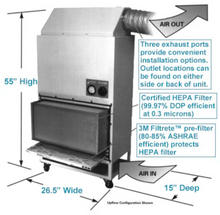
The most effective strategy is an integrated one: negative pressure to contain the smoke, and high-efficiency air purification to continuously scrub the air within the room. When customers ask us what to look for in a purifier for a smoking environment, the answer always comes down to two filtration stages:
For particulate matter (the "smoke"): The fine and ultrafine particles in smoke require high-efficiency filtration. A true HEPA filter is certified to capture at least 99.97% of airborne particles down to 0.3 microns, effectively trapping the soot, tar, and other solid components of smoke.
For gases and odors (the "smell"): HEPA filters are not designed to remove gases, chemicals, or VOCs. That's the job of adsorbent media. Systems with a substantial amount of activated carbon are critical for smoking applications — its porous structure adsorbs and traps gas and odor molecules. For the heavy chemical load of a smoking room, a deep-bed carbon filter with several pounds of carbon will be far more effective and last far longer than a thin, carbon-dusted sheet.
Size the in-room unit to keep pace with real-time smoking — for a residential room, aim for roughly 8–10 ACH from the purifier so the air stays breathable during the session.
The Complete Containment Protocol: A Pre-Smoking Checklist
For home setups, we recommend running through this checklist every session:
Seal the room: Close the door and any windows except the one holding the exhaust fan. Confirm HVAC vents are covered.
Provide makeup air: Crack a window open an inch or two in a distant room.
Engage the exhaust: Set the window fan to exhaust and run it at medium-high. You should feel a gentle draft pulling in under the door — that's your confirmation that negative pressure is established.
Start the purifier: Run your in-room HEPA/carbon purifier at medium-high.
Enjoy your smoke, knowing the odor is contained.
Run the purge cycle: After you finish, leave both the exhaust fan and the purifier running for at least 30–60 minutes to clear residual airborne pollutants from the room.
A Healthier Building Starts with Smarter Air Control
Creating a space that successfully contains tobacco smoke is not just about courtesy; it's about health, safety, and compliance. A "Designated Smoking Area" sign is not enough. By embracing the proven principles of negative pressure ventilation, you establish a reliable method of containment. By supplementing that system with high-performance, in-room air purification, you actively reduce contaminant levels at the source — creating a cleaner environment within the room and providing the ultimate defense against migration.
This integrated approach ensures you are not just masking an odor problem but fundamentally controlling the airflow and removing the harmful pollutants that put everyone's health at risk. Have questions about designing a smoking room for your facility or home? Contact our air quality specialists for a no-obligation consultation to make sure your space is safe, compliant, and odor-free.
Frequently Asked Questions (FAQ)
Q1: What is the difference between positive and negative air pressure? Negative air pressure is created when more air is exhausted from a room than is supplied, causing air to flow into the room from surrounding areas — it's used for containment. Positive air pressure is the opposite: more air is supplied than exhausted, so air flows out of the room. That's used in cleanrooms and medical environments to keep contaminants out.
Q2: Can a HEPA filter alone remove the smell of cigarette smoke? No. A HEPA filter is extremely effective at capturing the solid particles in smoke, but it cannot remove the odors, gases, and VOCs that make up the smell. For odor removal, you need a system that also includes a significant amount of activated carbon or another adsorbent media.
Q3: How much ventilation is required for a smoking room? Ventilation requirements are often dictated by local building codes and industry standards like those from ASHRAE, typically expressed in air changes per hour. Commercial smoking lounges require very high ACH rates — often 15 to 30 or more — to effectively dilute and remove contaminants. A qualified HVAC professional should calculate the specific needs for your space.
Q4: Why can't I just open the window in the room I'm smoking in and blow the smoke out? An open window creates unpredictable airflow. Depending on wind direction, outdoor temperature, and your building's HVAC system, an open window can just as easily pull air in from the hallway or push smoke out of your room into the rest of the building. A fan set to exhaust creates a guaranteed, one-way outward flow that is far more reliable.
Q5: I live in an apartment. Is installing a powerful window fan okay? In most cases, yes — a window fan is a non-permanent installation that doesn't alter the building. It's still wise to check your lease or with your building manager, and be considerate of where the exhaust points so it isn't blowing directly into a neighbor's window.
Q6: What if I can't completely seal my HVAC vents? Shared HVAC is the weakest link in any containment strategy. If air can be pulled into a central system that serves other rooms, some odor will inevitably circulate. Magnetic vent covers provide the best non-permanent seal — do the best you can, but understand any HVAC leak compromises full containment.
Q7: Is this containment system 100% foolproof? When executed correctly, this strategy is incredibly effective and will prevent the vast majority of smoke and odor from escaping the room. A true, laboratory-grade airtight seal is nearly impossible in a residential setting, but this professional method gets you as close to complete containment as is practically possible.
Q8: Is thirdhand smoke really dangerous? Yes. Research continues to show that the chemical residue left behind by tobacco smoke can remain on surfaces for weeks or months and can interact with other chemicals in the air to form new carcinogens. It poses a risk, especially to children and non-smoking adults who come into contact with contaminated surfaces.
Q9: Are negative pressure smoking rooms required by law? Regulations vary widely by country, state, and city. Many jurisdictions have Clean Indoor Air Acts that ban or heavily regulate indoor smoking. Where indoor smoking is permitted in designated areas, there are often strict requirements for independent ventilation and exhaust systems that prevent air from recirculating into non-smoking areas. A negative pressure design is the most common and effective way to meet these requirements — always consult your local building codes and health department.
Related guides
- The Blueprint: How to Build a Professionally Ventilated Home Cigar Room
- How to Calculate CFM & ACH for a Cigar Lounge: A Simple Guide
- Beyond Filters: The Role of Ventilation in Comprehensive Smoke and Odor Management
- The Ghost in the Room: Your Definitive Guide to a Permanent Cigar Odor Removal Solution
Ready to improve your air quality? Explore our Smoke Removal collection, or contact our team for a recommendation tailored to your space.