How to Remove Cigar Smoke & Odor: The Definitive Guide

By the Team at Commercial Air Purifiers
A premium cigar is a pleasure. The morning after — stale ash in the air, yellowing walls, a haze that won't quit — is not. Whether you're clearing a home cigar room so the rest of the house doesn't smell, or resetting a commercial lounge, the job breaks into two parts: remove the odor that's already embedded, then install equipment that keeps it from coming back. This is the step-by-step plan we walk operators and homeowners through, in order.
First, understand what you're removing
Cigar smoke is heavier and oilier than cigarette smoke or cooking odor, and it's really three problems:
- The haze (particulate): microscopic ash and tar particles, much of it PM2.5, that float for hours and settle as a sticky yellow film.
- The odor (gas phase): volatile organic compounds — benzene, formaldehyde, ammonia and more — among the thousands of chemicals the CDC counts in secondhand smoke. This is the stale smell that survives cleaning.
- Thirdhand smoke (residue): the tar and nicotine film that soaks into drywall, upholstery, carpet padding, and HVAC ducts, then slowly re-emits for months or even years. This is why a room can keep smelling of smoke long after the last cigar — and why running a purifier alone never fully fixes an already-contaminated room.
Get this straight up front, because it explains the plan: an air purifier captures airborne smoke, but it is an air cleaner, not a surface cleaner. To truly remove cigar odor you have to strip the embedded residue and capture the ongoing off-gassing. Here's how.
The plan at a glance
- Ventilate and stop adding smoke while you work.
- Remove or launder porous materials.
- Deep-clean every hard surface (two-bucket TSP wash).
- Seal and repaint with a shellac-based primer.
- Clean the HVAC and ducts.
- Install commercial filtration to keep the room clear for good.
For a badly saturated room, steps 2–5 are a full weekend or more. Don't skip ahead to buying a purifier first — capturing air in a room whose walls are still off-gassing is a losing battle.
Step 1: Ventilate and stop the source
Before cleaning, air the room out and stop smoking in it until the reset is done. Open windows, run an exhaust fan, and move air through. Just know ventilation alone is dilution, not removal — and exhausting conditioned air is expensive, because every 1,000 CFM you blow outside pulls in 1,000 CFM of makeup air you then pay to heat or cool. Ventilation is the opening move here, not the solution.
Step 2: Remove or launder every porous material
Soft, porous materials are sponges for smoke residue and will keep re-releasing odor no matter what else you do. Work through the room and deal with each:
- Launder or dry-clean drapes, curtains, cushion covers, throws, and any washable fabric.
- Deep-clean or replace upholstered furniture and area rugs. Carpet and carpet padding often hold so much residue that replacement is the honest answer in a heavily smoked room.
- Air out or discard books, papers, and cardboard — paper traps odor stubbornly and is rarely worth saving.
Whatever you can take out of the room and clean elsewhere, do. It makes every later step easier.
Step 3: Deep-clean all hard surfaces with a two-bucket TSP wash
Tar coats every hard surface, and wiping it with household spray just smears it. Use TSP (trisodium phosphate, a strong degreasing cleaner from any hardware store) and the two-bucket method: one bucket of TSP solution, one of clean rinse water. Wash a section, then rinse your cloth in the rinse bucket — never back into the cleaning solution — so you're lifting tar off, not redistributing it.
Clean top to bottom and don't miss the spots that hold the most residue:
- Walls and ceilings (the ceiling is often the worst — smoke rises)
- Cabinet faces and the tops of cabinets and shelves
- Ceiling-fan blades and light fixtures
- Outlet and switch covers, door and window trim
- Blinds, hard windowsills, and glass
Wear gloves and eye protection and follow the TSP label. You'll be surprised how much yellow comes off onto the cloth — that's the odor source leaving the room.
Step 4: Seal and repaint with a shellac-based primer
Here's the step people skip and then wonder why the smell came back: painting over smoke residue does not work. Nicotine and tar bleed straight through ordinary latex paint, both as a yellow stain and as odor. You have to seal it first with a shellac-based stain-blocking, odor-sealing primer. One to two coats locks the residue behind an impermeable barrier; then you repaint with your normal finish coat over the sealed surface. This single step is often the difference between “better” and “gone.”
Step 5: Clean the HVAC and ducts
Your heating and cooling system pulled smoke through it every time the room was used, and the ductwork now holds residue that re-contaminates clean air. Replace the HVAC filter, and for a seriously smoked space have the ducts professionally cleaned — look for a contractor certified by NADCA (the National Air Duct Cleaners Association). Otherwise the system quietly re-seeds the odor you just worked to remove.
Step 6: Install commercial filtration to keep it clear
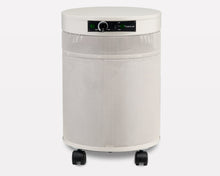
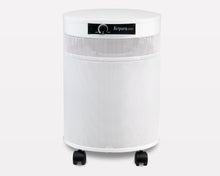
Once the room is stripped and sealed, the job shifts to keeping new smoke from ever settling again. This is where equipment matters — and where residential purifiers fail. Cigar smoke overwhelms plastic big-box units: they lack the airflow, the carbon is a token few ounces, and the plastic body itself absorbs tar and becomes the smell. You want a commercial-grade unit built for this.
Size it by air changes, not square footage
An active cigar room should turn its air over 15–20 times an hour (ACH) — the whole room scrubbed every three to four minutes — versus about 4 ACH in a normal room. Size by air volume:
Room volume (L × W × H) × target ACH ÷ 60 = required CFM
Example: a 15 ft × 20 ft room with 10 ft ceilings is 3,000 cubic feet. At 15 ACH: 3,000 × 15 ÷ 60 = 750 CFM. Buy headroom — a unit rated 1,000+ CFM run on medium delivers that quietly. Our CFM Calculator sizes it from your dimensions.
Look for the three-stage stack
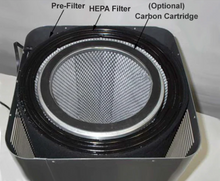
- Tar-barrier pre-filter (metal mesh or oil-mist pad) to condense and trap sticky tar before it clogs anything downstream.
- Deep-bed activated carbon — 15 to 30 pounds, ideally blended with potassium permanganate — to adsorb and oxidize the gas-phase odor. Pounds, not ounces.
- True HEPA (99.97% at 0.3 microns) to capture the fine ash and blue haze.
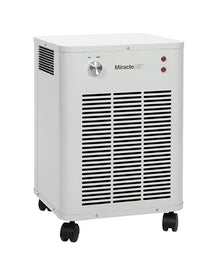
And insist on a steel housing. Metal is non-porous, so tar wipes off instead of soaking in; a steel unit never becomes the smell the way plastic does.
Mount it high
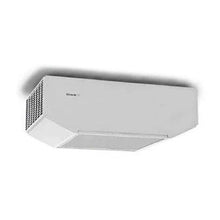
Smoke is hot and rises, so put the intake near the ceiling. In lounges we ceiling-mount units in the center of the room, where they draw smoke up from where it pools and push clean air out toward the walls. Never run a smoke unit on the floor — the smoke rises, cools, and falls before a floor unit can catch it, and everyone breathes it first. At home, one unit in the central living area; in a business, several units distributed across the floor.
Give it time. In a freshly reset room a good unit clears the visible haze within hours, but fully stabilizing a space that was heavily contaminated can take weeks of continuous running as the last of the residue is captured. It's a team effort between the deep clean and the machine.
What NOT to do
- Don't use ozone generators in occupied spaces. Ozone is a lung irritant and the EPA advises against running generators where people or pets are present. It only oxidizes the top layer of odor — the smell returns as residue keeps off-gassing — and it can degrade rubber and plastics. Stick to mechanical filtration.
- Don't rely on air fresheners, gels, or candles. They mask odor for an hour; they remove nothing.
- Don't buy a purifier and skip the cleaning. The machine handles the air, not the drywall. Both are required.
Keeping it fresh: maintenance
Filter life in a cigar environment is driven by volume, and your nose is the real test — if the room smells stale in the morning, the carbon is saturated. As a rule of thumb, replace carbon every 3–4 months in a commercial lounge and every 6–9 months in a home room, and wash or swap the tar-barrier pre-filter often to protect the rest of the stack. A lounge we outfitted with multiple commercial units saw the airborne odor drop within days of switching on, and the embedded smell fade over the following weeks as the deep clean and the filtration worked together.
Ready to pick equipment? Browse the Smoke Removal collection, or email info@commercialairpurifiers.net with your room size and peak smoker count and we'll size and quote it the same business day.
Related guides
- Best Cigar Air Purifiers: What Actually Works
- Cigar Smoke Eaters: How They Work & Which to Buy
- The Buyer's Guide to Commercial Air Purifiers for Cigar Lounges
- The Sticky Truth: Removing Tar From Your Indoor Air
References: CDC, “Secondhand Smoke Facts.” U.S. EPA, “Guide to Air Cleaners in the Home” and “Ozone Generators That Are Sold as Air Cleaners.” ASHRAE Standard 62.1. NADCA, air duct cleaning standards.