The Host's Dilemma: How to Eliminate Odors and Impress Guests with a High-End Air Purifier

By the Team at Commercial Air Purifiers | Published: November 9, 2025
You’ve curated the perfect evening. The menu is ambitious, the playlist is set, and the lighting is just right. Your home is a warm, welcoming haven for your guests. You sear the steaks, and a cloud of savory smoke fills the kitchen—part of the culinary charm, you think. The party is a success, filled with laughter, great food, and lively conversation.
Then, you wake up the next morning.
Your beautiful home smells like a cold, stale frying pan. That rich, savory smoke has become a sticky, acrid film. The aroma of garlic, seared fish, and wine now clings stubbornly to your curtains, your sofa, and your rugs.
This is the host's dilemma. Entertaining, by its very nature, creates a commercial-grade pollution event inside your home.
As experts in commercial air purification, we see this all the time. A standard, off-the-shelf residential air purifier—the kind you buy to handle a little dust in a bedroom—will fail, and fail completely, when faced with the "pollution spike" of a dinner party. To protect your home and ensure your guests' comfort, you need to think less like a homeowner and more like a restaurant manager. You need a high-end air purifier that brings commercial-grade technology into your living space.
What a Great Party Really Does to Your Air
We tend to think of "air pollution" as something that happens outside. But the U.S. Environmental Protection Agency (EPA) consistently reports that indoor air can be two to five times more polluted than the air outside.
And a party is an indoor pollution super-event.
It’s a multi-front assault on your air quality from sources you've invited in.
1. The Culinary Cloud: PM2.5 and VOCs
The single biggest culprit is your own kitchen. Searing, frying, roasting, and even toasting all release a complex cloud of pollutants.
-
Particulate Matter (PM2.5): This is the visible "smoke" from your searing pan. These are microscopic solid and liquid particles (30 times smaller than a human hair) that are a major lung irritant. A 2023 study by the University of Texas at Austin found that a single Thanksgiving-style meal can spike PM2.5 levels to more than 400 micrograms per cubic meter—11 times higher than the EPA's 24-hour health standard.
-
Volatile Organic Compounds (VOCs): This is the invisible "smell." As oils, fats, and wine deglaze a pan, they aerosolize into gaseous chemicals. This is what creates the rich aroma of garlic and herbs, but it's also what creates the stale, lingering odor the next day. The EPA lists cooking as a primary source of indoor VOCs like formaldehyde and acrolein.
2. The Guest Factor: Allergens and Bio-effluents
Your guests themselves are a source of pollutants. This isn't just about viruses (though that's a factor). It's about:
-
Allergens: Guests bring in pollen, dust, and mold spores from outside on their clothes and shoes.
-
Pet Dander: Even if you don't have a pet, a guest who does can bring in enough dander to trigger a reaction in another, more sensitive guest.
-
Perfumes and Colognes: A room full of different scents can be overwhelming and is a major trigger for people with chemical sensitivities.
A standard, $200 air purifier is built for one of these problems—maybe a little dust. It is completely overwhelmed by all of them at once. Its weak fan can't move enough air, and its tiny filter gets clogged or saturated in a single night.
The "Big 3" Features Your High-End Purifier Must Have
When we, as commercial air experts, spec a unit for a high-load environment, we ignore 90% of the marketing gimmicks. We look at three things: the particle filter, the gas filter, and the motor. A true high-end air purifier for entertaining excels at all three.
Feature 1: A "True" HEPA Filter (The Particle & Allergen Killer)
This is your defense against haze, smoke, allergens, and dust.
HEPA stands for High-Efficiency Particulate Air. It is a government-certified standard, not a marketing term. A "True" HEPA filter is certified to capture 99.97% of all airborne particles down to 0.3 microns in size.
This is the technology that traps the physical pollutants:
-
The PM2.5 smoke from your kitchen.
-
The pet dander and pollen from your guests' clothing.
-
The dust kicked up by foot traffic.
-
The viruses and bacteria your guests may be breathing out.
The Centers for Disease Control and Prevention (CDC) has clearly linked PM2.5 exposure to serious respiratory and cardiovascular problems. A HEPA filter is your non-negotiable first line of defense.
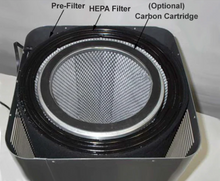
The High-End Difference: A cheap unit uses a small, flimsy HEPA filter. A high-end unit uses a large, thick, medical-grade HEPA filter with many more square feet of filter media. This means it can capture more particles while allowing for higher airflow (CFM) without the motor straining.
Feature 2: A Massive Activated Carbon Filter (The Odor & Gas Killer)
This is your defense against the smell. It is the most important feature for an entertainer.
A HEPA filter does nothing to stop odors.
Let me repeat that: HEPA filters do not remove smells. The smell of seared fish or stale wine is a gas (a VOC), and those gas molecules are thousands of times smaller than a particle. They pass right through a HEPA filter like it's not even there.
The only way to remove these gaseous chemicals is with activated carbon. It works through a scientific process called adsorption (with a "d"). The carbon is incredibly porous; a single pound of it can have a surface area of over 100 acres. As the air is forced through, the gas molecules get "stuck" in these microscopic pores.
The High-End Difference (This is the #1 secret): The amount of carbon is the single biggest difference between a $150 unit and a $1,500 unit.
-
A cheap unit: Contains a thin, paper-like filter "dusted" with a few ounces of carbon. This is like a single paper towel for a 10-gallon spill. It will become 100% saturated (full) in a single dinner party.
-
A high-end unit: Contains a deep-bed carbon filter packed with pounds of carbon—often 15, 20, or even 25 pounds. This massive "sponge" has the capacity to adsorb the intense VOC spike from a party and keep working for months or even years before it needs to be replaced.
From our experience, this is the first question you should ask: "How many pounds of carbon does it have?" If the answer isn't in pounds, it's not a high-end unit for odors.
Feature 3: A High CFM (Cubic Feet per Minute) Rating (The Power)
This is your defense against stagnation. It's the "horsepower" of your purifier.
CFM measures how much air the unit can move. This is directly tied to ACH (Air Changes per Hour), or how many times the purifier can clean the entire volume of air in your room every hour.
A weak, 100-CFM unit in a large living room might only achieve 0.5 ACH. It will never get ahead of the pollution. For a large entertaining space, you should be targeting 4-6 ACH.
You need a high-CFM motor for two reasons:
-
To create a powerful, circular airflow that pulls the smoky air from the kitchen and the perfumed air from the living room toward the unit.
-
To overcome the "back pressure" of those thick, heavy HEPA and carbon filters. A weak motor can't force the air through the very filters that make it effective.
A high-CFM, commercial-grade motor is the engine that makes the whole system work.
Beyond the Specs: The "Luxury" Features That Define "High-End"
Power and filtration are the "must-haves." But for a high-end entertaining space, the experience of the purifier matters just as much. These are the features that separate a "prosumer" machine from an industrial one.
1. Whisper-Quiet Operation
This is a deal-breaker for a host. You can't have a machine roaring like a jet engine while you're trying to have an intimate conversation over dinner. A cheap purifier on "high" can easily top 60-70 decibels (dB), the sound of a vacuum cleaner.
High-end units are an investment in silence. They achieve this by:
-
Using oversized, powerful motors: This is counter-intuitive, but a big motor running at 40% speed is far quieter (and more effective) than a small motor straining at 100%.
-
Using EC Motors: More advanced "Electronically Commutated" motors are more efficient and significantly quieter than standard AC motors.
-
Superior Build Quality: A cheap plastic housing will rattle and vibrate. A high-end unit with a powder-coated steel or aluminum housing and internal sound-dampening insulation will just produce a gentle "whoosh."
2. Smart Sensors and "Auto Mode"
A good host should be focused on their guests, not on their appliances. The best high-end purifiers have Auto Mode driven by smart sensors.
-
Particle Sensor (PM2.5): This sensor "sees" the smoke from your kitchen, the dust kicked up, or the dander from a guest's coat.
-
VOC Sensor (Gas): This sensor "smells" the cooking odors, the wine, the perfume, and even the CO2 from your guests' breath.
In "Auto Mode," the unit sits at a silent low speed. But the second you start searing that steak or a cloud of perfume walks in, the sensors detect the pollution spike and automatically ramp up the fan to high. It tackles the problem instantly, then fades back into the background. It's proactive, not reactive.
3. Aesthetics and Build Quality
A high-end air purifier should look like a piece of high-end audio equipment or minimalist furniture, not a piece of medical equipment. The "luxury" component is that it blends in. Steel housings, premium finishes, and thoughtful, non-intrusive designs are hallmarks of a high-end unit. It should complement your decor, not detract from it.
Where to Place Your Purifier for a Party: A Host's Guide
From our experience, where you put the machine is almost as important as which machine you buy.
-
THE WORST SPOT: Tucked in a corner or behind a sofa. This "airflow obstruction" suffocates the unit, and it ends up just cleaning a small bubble of air around itself.
-
THE BEST SPOT (Option 1): The "Scout" Position. Place the unit on the border between the kitchen and the dining/living area. It will act as a "scout," capturing smoke and cooking VOCs at the source, before they can travel and settle in the rest of your home.
-
THE BEST SPOT (Option 2): The "Living Room" Position. Place it in your main entertaining space, against a wall with at least 2-3 feet of clearance. This will create a large, circular airflow pattern, constantly scrubbing the air your guests are breathing of allergens, viruses, and dust.
Pro-Hosting Tip: Turn your unit on "High" or "Turbo" for one hour before guests arrive. This creates a baseline of pure, clean air. When guests arrive, switch the unit to "Auto Mode." It will run silently until it's needed, then attack any new pollutants on its own.
The Verdict: An Investment in Hospitality
A high-end air purifier is not an appliance; it's a piece of hospitality infrastructure.
It's an investment that pays you back in multiple ways:
-
It protects your other investments: Your furniture, curtains, and rugs won't absorb those stubborn odors.
-
It protects your guests: The guest with the cat allergy can breathe easy. The guest with asthma won't be bothered by the cooking smoke.
-
It protects you: You get to wake up the morning after a fantastic party to a home that smells as fresh and clean as it did before you ever started cooking.
That peace of mind—and the ability to entertain without hesitation—is the true luxury.
Ready to make your home the ultimate space for entertaining? Browse our curated collection of high-performance air purifiers designed to handle anything a great party can throw at them. For specific allergen concerns, our Pet & Allergy collection features units with the robust HEPA filtration you need.
Frequently Asked Questions (FAQ)
Q: How long should I run the air purifier after a party?
A: We recommend running it on "High" for at least 2-3 hours after your last guest leaves to "scrub" any remaining, lingering pollutants. After that, you can return it to "Auto Mode" or a quiet, low-speed setting for 24/7 maintenance.
Q: Will an air purifier really help my guests with pet allergies?
A: Absolutely. A True HEPA filter is the gold standard for removing airborne pet dander, which is the primary trigger for most pet allergies. Running the unit before they arrive will dramatically reduce the dander in the air.
Q: Is a $1,000+ air purifier really worth the money?
A: Yes, because you are paying for capacity and longevity. A cheap unit with a 2-ounce carbon filter is a disposable item that will fail at its one job (removing odor). A high-end unit with a 15-pound carbon filter is an investment that will perform effectively for years. You are paying for filters that last for 1-3 years, not 1-3 months.
Q: What about ionizers or ozone generators for odors?
A: We strongly advise against them. The EPA has issued clear warnings that ozone generators are not effective at removing indoor air pollutants and are, in fact, a powerful lung irritant. Never use an ozone generator in an occupied space. A media-based (HEPA + Carbon) system is the only safe and proven solution.