The Invisible Amenity: Why Clean Air is the New Standard for Boutique Fitness Studios

By the Team at Commercial Air Purifiers
In the world of boutique fitness, the client experience is everything. You curate the playlists, you hire the most charismatic instructors, you invest in high-end flooring, and you stock the locker rooms with luxury grooming products. You charge a premium because you offer a premium environment.
But there is one element that can undermine all that investment the moment a client walks through the door: the smell.
We have all experienced it. You walk into a spin studio, a boxing gym, or a hot yoga room, and you are hit with a wall of warm, stagnant, humid air that smells of sweat, rubber, and carbon dioxide. In the industry, we call it the "locker room effect," but to your clients, it just feels... dirty.
For a long time, this was just accepted as the smell of hard work. But in a post-pandemic world, clients are hyper-aware of what they are breathing. They know that a stuffy room isn't just unpleasant; it’s a sign of poor ventilation and a potential vector for airborne illness.
At Commercial Air Purifiers, we believe that clean air is the ultimate luxury amenity. It is the invisible signal that tells your members you care about their health. But creating that environment in a high-density, high-sweat facility requires more than a plug-in air freshener or a residential air purifier from a big-box store. It requires industrial physics.
The Biology of the "Sweatbox"
To understand why standard air purification fails in fitness studios, you have to understand the biological load of your environment. A boutique fitness studio is arguably the most challenging indoor environment to manage, rivaling even restaurant kitchens.
1. The Respiration Rate Factor
In an office, people are sitting still, breathing shallowly. In a HIIT class or spin session, your clients are performing at maximum output. According to data from the Centers for Disease Control and Prevention (CDC), a person undergoing heavy physical exertion breathes in and out up to 20 times more air volume than a person at rest.
This means two things:
-
Emission: They are expelling massive amounts of CO2, aerosols, and droplets into the room.
-
Intake: They are inhaling pollutants from the room deeper into their lungs than they would in a resting state.
2. The "Human Cloud"
When 30 people are sweating in a 1,000-square-foot room, the humidity spikes. Bacteria thrive in humidity. The characteristic "gym smell" is actually the off-gassing of bacteria consuming the proteins in sweat. When you combine this with the off-gassing (VOCs) from rubber mats and cleaning chemicals, you create a chemical cocktail that standard HVAC filters cannot touch.
3. The Density Issue
Boutique studios rely on maximizing square footage. You pack mats inches apart. This density creates a "viral load" challenge. If one person is sick, the heavy respiration combined with close proximity makes transmission highly likely unless the air is being scrubbed aggressively.
Why Residential Units Fail in the Gym
We often visit studios where the owner has bought four or five sleek, plastic air purifiers designed for bedrooms and placed them in the corners of a CrossFit box. They usually report that the units are noisy, the filters clog in weeks, and the smell hasn't gone away.
This is a classic case of under-engineering. Here is why residential units cannot handle the rigors of a gym:
-
Plastic vs. Medicine Balls: A gym is a kinetic environment. Equipment gets thrown; people bump into walls. A plastic residential unit will crack if a kettlebell rolls into it. Commercial units are housed in powder-coated steel. They are built to take a beating.
-
The "CFM" Deficit: Most residential units top out at 200–300 CFM (Cubic Feet per Minute). To scrub the air of a high-intensity class effectively, you need to move the air much faster than that. You need industrial velocity to ensure the air in the center of the room is actually being pulled into the filter.
-
Filter Surface Area: A residential carbon filter is often a thin, impregnated foam sheet. It might weigh a few ounces. In a sweaty gym, that carbon will be saturated with odors in 48 hours. Once saturated, it stops working. Commercial units use canisters containing pounds of activated carbon, designed to adsorb odors for months.
The Two-Front War: Particulates and Odors
When engineering a solution for a fitness studio, we treat it as a two-front war. You need a machine that can handle both solids and gases.
Front 1: Particulates (Viruses, Dust, Chalk)
In a CrossFit gym, you have magnesium carbonate (chalk) dust. In a spin studio, you have respiratory droplets.
-
The Solution: True HEPA Filtration.
-
The Science: HEPA (High-Efficiency Particulate Air) filters capture 99.97% of particles at 0.3 microns. This captures the visible dust and the invisible viral aerosols.
-
The Commercial Edge: In a gym, a HEPA filter needs protection. Commercial units use substantial pre-filters to catch the big dust bunnies and hair, ensuring the expensive HEPA filter is saved for the microscopic threats.
Front 2: Gases (Body Odor, Rubber, Cleaning Fumes)
HEPA filters do not stop smells. If you put a HEPA-only unit in a locker room, the air will be dust-free, but it will still smell like a locker room.
-
The Solution: Deep-Bed Activated Carbon.
-
The Science: Carbon works by adsorption. The gas molecules of the odor get trapped in the microscopic pores of the carbon.
-
The "Overkill" Requirement: You cannot skimp on carbon weight. To remove the smell of 30 sweating people, you need a unit with at least 15 to 30 pounds of carbon. This provides the "dwell time" necessary to strip the air of organic compounds.
The CFM Rule: How to Size Your Studio
This is the most critical section for any studio owner. Do not rely on "square footage" ratings on a box. A 500 sq ft bedroom is not the same as a 500 sq ft spin room. The biological load is completely different.
You must size based on Air Changes Per Hour (ACH).
-
Yoga/Pilates (Low Impact): Aim for 4–6 ACH.
-
Weight Room/Lobby: Aim for 6–8 ACH.
-
Spin/HIIT/Hot Yoga: Aim for 8–12 ACH.
The Calculation:
To find the power you need, use this formula:
$\text{Room Volume (L x W x H)} \times \text{Desired ACH} / 60 = \text{Required CFM}$.
Example:
A Spin Studio is 25’ x 30’ with 12’ ceilings.
Volume = 9,000 cubic feet.
You want 10 Air Changes Per Hour (because it gets intense).
$(9,000 \times 10) / 60 = 1,500 \text{ CFM}$.
You need 1,500 CFM of power. A standard residential unit gives you 250 CFM. You would need six of them. Or, you could install two robust commercial units running on medium speed.
Don't Guess. We have built a tool specifically for this. Before you buy anything, plug your studio’s dimensions into our CFM Calculator. It will give you the hard numbers you need to guarantee clean air.
Zone-Specific Strategies
Not all rooms in your facility are created equal. Here is how we recommend deploying "Overkill" engineering across different zones.
1. The High-Intensity Studio (Spin, Barry’s, CrossFit)
-
The Challenge: Extreme CO2, humidity, and aerosols.
-
The Solution: High CFM is king here. You need air movement.
-
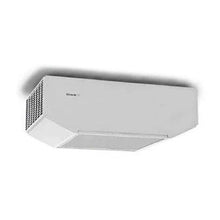
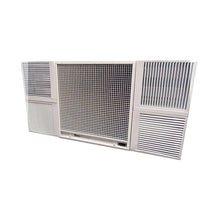
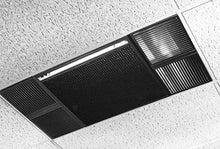
Recommendation: Ceiling-mounted or wall-mounted commercial scrubbers. Getting the units off the floor protects them from equipment and saves floor space for clients. Look for units that combine HEPA with moderate Carbon.
2. The Mind-Body Studio (Yoga, Pilates, Barre)
-
The Challenge: Silence. You cannot have a jet engine running during Savasana.
-
The Solution: Oversized units running on "Low."
-
Recommendation: Buy a unit rated for double the CFM you actually need. Run it at 30% speed. It will be whisper-quiet but still move enough air to keep the room fresh.
-
Hot Yoga Note: Humidity breeds mold. Ensure your units have moisture-resistant filters and that you are checking pre-filters weekly.
3. The Locker Room
-
The Challenge: Odor. Pure and simple.
-
The Solution: Carbon is king here. HEPA is secondary.
-
Recommendation: A dedicated "Smoke Eater" style unit (typically used in cigar lounges) is actually perfect for locker rooms because it is designed specifically to scrub heavy organic odors.
The Marketing Value of Clean Air
We encourage studio owners to stop thinking of air purification as a maintenance cost and start viewing it as a marketing asset.
In a competitive market, you need differentiators.
-
The Trust Factor: Place a small placard at the front desk: "For your health, our air is scrubbed 10 times per hour by hospital-grade HEPA filtration."
-
The Retention Factor: Clients may not consciously realize why they prefer your studio over the one down the street, but they will notice that they don't get a headache from the smell and that the air feels "lighter."
-
The "Fresh" Brand: If you sell high-end apparel or smoothies in your lobby, you cannot have the smell of the workout room bleeding into the retail space. Negative pressure air scrubbing keeps the smells contained.
Frequently Asked Questions
Q: Won't the noise distract the class?
A: In a HIIT or Spin class with loud music, commercial purifiers are undetectable. In a Yoga class, "White Noise" is often desirable to mask traffic sounds outside. However, the key to silence is oversizing. A large fan moving slowly is quiet; a small fan spinning fast is loud. Buy big, run low.
Q: Can I just open the garage doors?
A: Ventilation (fresh air) is great, but it introduces outdoor problems—pollen, street noise, humidity, and exhaust fumes. Opening doors also kills your AC efficiency. Mechanical purification allows you to control the environment regardless of the weather outside.
Q: Does UV light help in gyms?
A: UV-C can be a good supplement for killing bacteria on coils or inside ducts, but for a standalone unit in a gym, mechanical filtration (HEPA) is more reliable. HEPA physically traps the pathogen. UV requires "dwell time" to kill it. In a high-velocity airflow room, HEPA is the surer bet.
Q: How often do filters need changing in a gym?
A: More often than in an office. The "human dust" (skin cells) and lint from towels clog pre-filters quickly.
-
Check Pre-filters: Monthly. Vacuum or wash them.
-
Carbon/HEPA: Every 6–12 months, depending on class density.
Conclusion: Breathing is Your Business
Your clients come to you to improve their bodies, clear their minds, and breathe deeply. If the air they are breathing is stale, laden with bacteria, or smelling of chemicals, you are breaking the promise of "wellness."
By upgrading to commercial-grade air purification, you are protecting your clients, protecting your staff, and protecting your brand. You are moving from a reactive stance (masking odors) to a proactive stance (eliminating pollutants).
Don't let your studio be known as the "sweaty one." Make clean air your signature amenity.
Start by calculating the exact airflow you need to turn your sweatbox into a sanctuary. Use our CFM Calculator today. Once you have your numbers, shop our collection of Commercial Air Scrubbers and Smoke Eaters to find the heavy-duty solution that fits your studio.
References:
-
Centers for Disease Control and Prevention (CDC). "Ventilation in Buildings."
-
World Health Organization (WHO). "Indoor Air Quality: Selected Pollutants."
-
ASHRAE. "Standard 62.1: Ventilation for Acceptable Indoor Air Quality."
-
U.S. Environmental Protection Agency (EPA). "Indoor Air Quality in Commercial and Institutional Buildings."
Ready to improve your air quality? Explore our Air Cleaners & Purifiers collection, or contact our team for a recommendation tailored to your space.