The "Non-Toxic" Air Purification Guide: What to Use (And What to Avoid) for a Truly Healthy Home

By the Team at Commercial Air Purifiers | Published: November 17, 2025
You've made a commitment to a healthier, cleaner home. You buy organic food, use "green" cleaning supplies, and are mindful of the products you bring into your life. So, you decide to invest in an air purifier, an appliance whose entire purpose is to remove harmful pollutants and make your home's air safer to breathe.
But what if the very machine you bought to solve your air quality problem was actually adding a new, toxic pollutant to your air?
It’s a scenario we, as air quality experts, see far too often. The market is flooded with "air cleaners" that use technologies that can create harmful byproducts, trading one invisible threat for another.
A "non-toxic home air purification" strategy isn't just about what you remove from the air. It’s about what you don't add back in. In this expert guide, we'll give you a "no-gimmick" framework for choosing a system that is both powerful and, most importantly, truly safe.
Your Home: The "Sealed Box" of Modern Life
To understand the solution, you must first understand the problem. The modern home is an "energy-efficient," sealed box. This is great for your heating bill, but it's a disaster for your air.
The U.S. Environmental Protection Agency (EPA) has consistently reported two stunning facts:
-
Americans, on average, spend about 90% of their time indoors.
-
In those indoor spaces, concentrations of some pollutants are often two to five times higher than typical outdoor concentrations.
Your home is trapping and concentrating a complex cocktail of pollutants. To purify this air, you are fighting a war on two separate fronts.
The War on Particles (PM2.5)
This is the physical "stuff" floating in your air. It’s called Particulate Matter (PM2.5), and it's 30 times smaller than a human hair. The Centers for Disease Control and Prevention (CDC) links these fine particles to aggravated asthma, lung damage, and heart problems because they are small enough to get deep into your lungs and bloodstream.
Primary Sources:
-
Outside: Wildfire smoke, urban pollution, pollen, and smog.
-
Inside: Pet dander, dust mites, mold spores, and cooking smoke.
The War on Gases (VOCs)
This is the invisible, chemical side of the problem. Volatile Organic Compounds (VOCs) are gaseous pollutants that cause that "stale" smell or "new house smell." The EPA lists common sources as new furniture, paint, carpets, cleaning supplies, and even cooking.
These gases include known carcinogens like formaldehyde and benzene. They are what cause the headaches, dizziness, and "scratchy throat" feeling you get in a poorly ventilated room.
A non-toxic solution must effectively defeat both of these pollutant types, and it must do so without creating a third one.
The Core Concept: Passive vs. Active Air Purification
As air quality professionals, we categorize all purifiers into two philosophies. This is the most important concept you need to understand.
-
Passive Purification (The "Trap")
This is a "non-toxic" philosophy. A passive system uses a physical filter to trap and remove pollutants from the air. Think of it as a highly advanced, microscopic net. It adds nothing to your air. It only takes pollutants away.
-
Active Purification (The "Attack")
This is the "potentially toxic" philosophy. An active system works by creating a new substance (like ozone, ions, or hydroxyl radicals) and sending it out into your room to attack pollutants. It tries to "neutralize" them by changing their chemical structure. The problem? This process is often uncontrolled, incomplete, and can create new, harmful byproducts.
For a truly non-toxic home, we always recommend a Passive (Trap) solution. Let's look at why the "active" technologies are a risk you shouldn't take.
The "Toxic" Tech: 3 Technologies to Avoid for a Healthy Home
If your goal is a non-toxic environment, you must be a skeptical shopper. Many popular technologies are, at best, ineffective and, at worst, dangerous.
1. The #1 Culprit: Ozone Generators
These are the most dangerous products on the market, and they are often deceptively marketed as "activated oxygen" or "natural" air cleaners.
Here is the truth: Ozone (O3) is a toxic gas. The EPA's public warning, "Ozone Generators that are Sold as Air Cleaners," is crystal clear.
-
Ozone is a Lung Irritant: It is the main ingredient in smog. When you inhale it, it can damage your lungs, worsen asthma, aggravate bronchitis, and compromise your body's ability to fight respiratory infections. The EPA states flatly, "it is not always safe to use ozone generators in occupied spaces."
-
It Doesn't Even Work: The EPA's research also shows that for ozone to actually clean the air, it must be at a concentration far above public health standards (i.e., at a level that is dangerous to breathe). At concentrations that are "safe," it is ineffective at removing most pollutants.
From our expert position, there is zero reason to ever use an ozone generator in your home. It is a toxic, unregulated, and ineffective product.
2. The "Risky" Tech: Ionizers (and Electrostatic Precipitators)
Ionizers are very popular. They "charge" particles in the air, making them "stick" to a collector plate or, even worse, to your walls, furniture, and lungs.
The Hidden Risk: As a byproduct of creating that electrical charge, many ionizers create ozone. The EPA confirms this. While it's typically a much smaller amount than a dedicated ozone generator, why would you intentionally add any amount of a known lung irritant to your air when perfectly safe alternatives exist?
3. The "Gimmick" Tech: PCO (Photocatalytic Oxidation)
PCO sounds like incredible science-fiction. It uses UV light to strike a catalyst (like titanium dioxide), which creates hydroxyl radicals that are supposed to "destroy" pollutants.
The Hidden Risk: The chemical reaction is often incomplete. Research has shown that when a PCO unit tries to break down complex VOCs, it can fail, creating a slew of new, potentially more harmful byproducts—including formaldehyde and acetone. You are, in effect, running a tiny, uncontrolled chemical plant in your living room.
Why take any of these risks? A non-toxic home demands a solution that is proven, safe, and adds nothing to your air.
The Gold Standard: A "Non-Toxic" Dual-Filter System
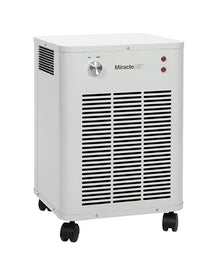
This brings us back to the "Passive (Trap)" philosophy. This is the solution used in medical cleanrooms, hospitals, and high-tech labs for a reason: it is 100% effective, 100% safe, and produces zero byproducts.
A non-toxic purification strategy requires two distinct filters to defeat the two distinct types of pollutants.
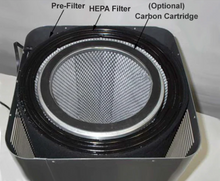
Tool 1: The "True" HEPA Filter (The Particle Shield)
-
What It Is: A medical-grade, certified filter. "True HEPA" is a legal standard set by the U.S. government. It is not "HEPA-type," "HEPA-like," or "99% HEPA."
-
How It Works: It is a physical net made of dense, tangled fibers. It is certified to trap and remove 99.97% of all airborne particles down to 0.3 microns.
-
Why It's Non-Toxic: It's a simple, physical trap. It doesn't "kill" or "change" anything. It just removes the problem. This is your non-toxic solution for dust, pollen, pet dander, mold spores, and the PM2.5 from wildfire smoke. It is the single most effective and safest technology for particle removal.
Tool 2: The Activated Carbon Filter (The Gas & Odor Shield)
-
What It Is: This is the only proven, passive, non-toxic technology for removing gases and chemicals.
-
How It Works: It works by a process called adsorption. The carbon is "activated" to be incredibly porous. As the air is forced through it, the gaseous VOC molecules (like formaldehyde and benzene) and odor molecules get physically "stuck" in this massive, microscopic maze.
-
Why It's Non-Toxic: Like HEPA, it's a physical trap. It's not a chemical reaction. It's a "gas sponge" that simply holds onto the pollutants.
This is our #1 expert insight: The amount of carbon is the only thing that matters. The "carbon-dusted" filters in 90% of residential units are a gimmick. They have a few ounces of carbon and will become saturated (full) in a matter of weeks, at which point they stop working.
For a new home with off-gassing furniture, or a home with high chemical or odor loads, you must have a system with a robust, deep-bed activated carbon filter. We're talking 15, 20, or even 30+ pounds of carbon. This is the only way to get a non-toxic solution with the capacity to handle a real-world gas-phase problem.
Your Action Plan: How to Implement a True Non-Toxic Strategy
You've committed to the safe, effective "HEPA + Carbon" strategy. Now, you have to make sure it's powerful enough to work. A perfect filter with a weak fan is a useless (but expensive) doorstop.
Step 1: Calculate Your True Power Need (CFM)
You cannot trust the "square foot" rating on a box. That number is a marketing gimmick that assumes 8-foot ceilings and often only cleans the air once or twice an hour (1-2 ACH).
For a truly healthy home, you need to clean the entire volume of your air 4 to 6 times per hour (4-6 ACH).
To do this, you must calculate your Target CFM (Cubic Feet per Minute).
-
Calculate Your Room Volume:
[Length (ft)] x [Width (ft)] x [Ceiling Height (ft)] = Room Volume (cubic feet)
-
Example: A 25ft x 20ft great room with 10ft ceilings = 5,000 cubic feet
-
-
Calculate Your Target CFM:
[Room Volume] x [Target ACH] / 60 minutes = Target CFM
-
Example: (5,000 cubic feet x 4 ACH) / 60 = 333 CFM
-
Your room needs a purifier that can provide 333 CFM of continuous, filtering power. To find the exact number for your unique space, we’ve built a professional tool. Visit our CFM Calculator and get your real-world target.
Step 2: The "Quiet" Secret: Oversize Your Unit
A purifier that is struggling at its 100% "turbo" speed is loud, annoying, and will burn out.
The secret to a quiet and non-toxic system is to buy a unit that is more powerful than you need.
If your Target CFM is 333, don't buy a 350 CFM unit. Buy a high-quality, 700 CFM unit. Why? Because you can run it on its 50% "medium" or "low" setting. At this level, it will be whisper-quiet, but it will still be delivering the 350 CFM you need. This "over-engineered" approach is the key to getting both performance and peace.
Conclusion: "Non-Toxic" Is a Choice, Not a Buzzword
A non-toxic home is a sanctuary. Protecting it isn't about marketing gimmicks that promise to "destroy" or "neutralize" pollutants. It's about a simple, proven, physical strategy: remove, don't change.
By choosing a system built on the two gold-standard, passive technologies—True HEPA for particles and Substantial Activated Carbon for gases—you are choosing a solution that is 100% effective and 100% safe. You are guaranteeing that the only thing your purifier will ever add to your home is clean, fresh, and truly healthy air.
Ready to find a true, non-toxic solution with the power to back it up? Explore our collection of HEPA and Activated Carbon Air Purifiers. Or, if you're battling the "new house smell," dive deeper into our systems for VOCs & Chemicals.
Frequently Asked Questions (FAQ)
Q: What is ozone, and why is it so bad?
A: Ozone (O3) is a highly reactive, toxic gas. It is the primary ingredient in smog. The EPA explicitly warns against using ozone generators in homes, as inhaling it can damage the lungs, inflame the airways, worsen asthma, and reduce the body's ability to fight respiratory infections.
Q: Are ionizers and "plasma" purifiers safe?
A: Many of these "active" technologies create ozone as an intentional or unintentional byproduct. From our expert perspective, the risk is not worth the benefit, especially when the "passive" HEPA/carbon solution is 100% safe and proven. Why risk adding any amount of a known lung irritant to your air?
Q: What's the difference between "True HEPA" and "HEPA-type"?
A: "True HEPA" is a U.S. government-certified, medical-grade standard that must capture 99.97% of particles at 0.3 microns. "HEPA-type," "HEPA-like," or "99% HEPA" are marketing terms with no legal definition. They often only capture 85-95% of particles and will miss the most damaging, ultra-fine ones. Always look for the "True HEPA" certification.
Q: My "non-toxic" purifier has a weird smell. What's wrong?
A: If it's a new HEPA/Carbon unit, the smell might be the new filters off-gassing (which should fade in 24-48 hours). However, if your unit is an active technology (ionizer, PCO, etc.), the "sharp" or "metallic" smell you're noticing is likely ozone. This is a sign that the unit is adding a toxic pollutant to your air, and you should stop using it. A passive HEPA/carbon system should be completely odorless.
Ready to improve your air quality? Explore our Chemical Sensitive / MCS collection, or contact our team for a recommendation tailored to your space.