Unlocking the Power of Activated Charcoal as an Air Purifier: The Science of Odor Removal

By the Team at Commercial Air Purifiers
We have all been there. You walk into a room—maybe it’s a freshly painted office, a nail salon, a basement after a flood, or a home with a heavy smoker—and the smell hits you like a wall. It’s heavy, cloying, and headache-inducing.
You might have already tried running a standard air purifier. You let it run on "High" for two days, and while the dust might be gone, that smell remains stubborn. Why? Because you are trying to catch a ghost with a butterfly net.
Standard air filters, even high-end HEPA filters, are designed to catch solids (dust, pollen, smoke particles). But odors, chemicals, and fumes are gases. A gas molecule is millions of times smaller than a dust particle. It passes right through a HEPA filter as if it weren't even there.
To trap a gas, you need a completely different technology. You need Activated Charcoal (industry professionals typically refer to it as Activated Carbon). It is the only safe, effective way to strip volatile chemicals and odors from the air.
At Commercial Air Purifiers, we specialize in "Overkill" engineering. We don't deal in gimmicks. We know that if you want to remove the smell of cigar smoke or industrial epoxy, a thin "charcoal sheet" won't cut it. You need pounds of media, heavy steel housing, and the physics of adsorption. Here is everything you need to know about using activated charcoal as an air purifier.
The Invisible Threat: Volatile Organic Compounds (VOCs)
Before we explain how charcoal works, we need to identify what it is fighting. The "smells" you detect are usually Volatile Organic Compounds (VOCs). These are carbon-based chemicals that evaporate easily at room temperature.
-
Sources: Paint, cleaning supplies, new furniture (formaldehyde), hair spray, nail polish remover (acetone), and tobacco smoke.
-
The Health Risk: According to the Environmental Protection Agency (EPA), concentrations of many VOCs are consistently up to ten times higher indoors than outdoors. Long-term exposure can lead to liver damage, kidney damage, and central nervous system damage.
This is why "masking" the odor with air fresheners is dangerous. You are covering up a toxicity warning signal. To make the air safe, you must physically remove the gas molecules from the room.
The Science: Adsorption (Not Absorption)
Activated charcoal works through a process called Adsorption (with a "d").
-
Absorption is like a sponge soaking up water; the water fills the spaces between the sponge fibers.
-
Adsorption is like a magnet. The gas molecules are chemically attracted to the surface of the charcoal and stick to it.
What makes it "Activated"? Activated charcoal isn't just burnt wood. It is carbon that has been treated with oxygen at incredibly high temperatures to open up millions of microscopic pores between the carbon atoms.
This creates a mind-boggling amount of surface area. One pound of activated carbon has a surface area equivalent to approximately 100 acres.
When dirty air is forced through a bed of activated charcoal, the VOCs and odors get trapped inside these microscopic pores. The air that comes out the other side isn't just "filtered"; it is chemically stripped of impurities.
The "Weight" Rule: Why Residential Units Fail
This is the single most important factor in choosing an air purifier for odors: Weight Matters.
If you go to a big-box store, you will see residential air purifiers boasting a "Charcoal Filter." If you open the box, you will usually find a thin, black, foam-like sheet. This is a "carbon-impregnated pre-filter." It contains perhaps a few ounces of carbon dust.
The Commercial Reality:
-
Residential Unit (Ounces): A few ounces of carbon will reach "saturation" (become full) in a matter of days in a smelly environment. Once saturated, it stops working entirely and can even start releasing the odors back into the room (off-gassing).
-
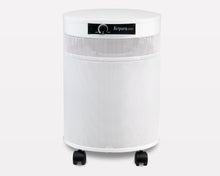
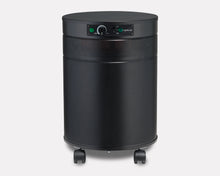
Commercial Unit (Pounds): A true commercial air scrubber uses deep-bed canisters containing 5, 15, or even 30 pounds of granular activated carbon.
At Commercial Air Purifiers, we often tell business owners: "You can't scrub a cigar lounge with a carbon sheet." To handle continuous odor generation—whether from a print shop, a kitchen, or a renovation—you need massive capacity.
The Physics of "Dwell Time"
Using activated charcoal as an air purifier isn't just about having the carbon; it is about how long the air stays in contact with it. This is called Residence Time or Dwell Time.
If you blast air through a thin filter at high speed, the gas molecules fly past the carbon pores before they can be grabbed. This is why high-speed residential fans often fail at odor control.
Commercial units are engineered to balance Airflow (CFM) with Dwell Time.
-
Deep Beds: The air is forced through a carbon bed that is 2 to 4 inches thick. This ensures the air takes longer to pass through, giving the charcoal time to adsorb the chemicals.
-
High Static Pressure: Pushing air through a thick bed of granules is hard work. It creates resistance. You need an industrial, high-torque motor to push the air through without burning out. Residential plastic fans simply cannot generate the static pressure required for deep-bed carbon filtration.
Specific Applications for Activated Charcoal
While HEPA filters are great for general allergies, Activated Charcoal is mandatory for these specific environments:
1. Smoke Remediation (Tobacco and Wildfire) Smoke is a combination of particulate (ash) and gas (VOCs).
-
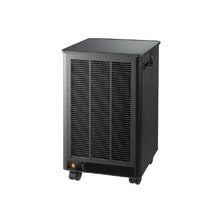
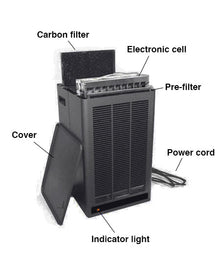
The Setup: You need a commercial "Smoke Eater" with a pre-filter for the tar, a HEPA filter for the ash, and a massive Carbon bed (10+ lbs) for the smell. Without the carbon, the room will still smell like stale smoke even if the air looks clear.
2. Salons and Spas Nail salons deal with acetone, acrylic monomers, and keratin treatments (formaldehyde). These are heavy gases that sink to the floor.
-
The Setup: A unit with "pounds, not ounces" of carbon is the only way to protect staff from "Salon Lung."
3. Post-Disaster Restoration After a fire or a flood, the "smell of destruction" (mildew or char) lingers in the drywall.
-
The Setup: Restoration contractors use heavy-duty scrubbers with activated carbon to "polish" the air during the final days of the job, ensuring the client returns to a home that smells neutral.
How to Size Your Solution: The CFM Rule
Just like with particulate filtration, you cannot guess at the size of the unit. You need to move enough air to keep up with the odor generation.
If you have a 2,000-cubic-foot room where people are smoking, and you use a small unit moving 100 CFM, the smoke is being generated faster than it is being removed.
The "Overkill" Calculation for Odor: For odor control, we recommend higher air exchange rates than for standard dust control.
-
Light Odors (Home/Office): 4–6 Air Changes Per Hour (ACH).
-
Heavy Odors (Smoke/Chemicals): 10–15+ Air Changes Per Hour (ACH).
The Formula:
Example: A 1,500 sq ft print shop (heavy ink smell) with 10 ft ceilings = 15,000 cubic feet. To get 10 air changes per hour: .
You need 2,500 CFM of filtration power. This is industrial territory. A standard home unit moves ~200 CFM. You would need 12 of them. Or, you could install two or three commercial air scrubbers.
Don't Guess. Use our CFM Calculator to determine exactly how much power your space needs.
Frequently Asked Questions
Q: Can I wash an activated charcoal filter? A: No. Once the pores are full of chemicals, they are full. Washing it with water does not remove the bonded gas molecules. In fact, getting charcoal wet can ruin it and promote mold growth. When the filter is saturated (you can tell because the smell returns), you must replace the media.
Q: How long does activated charcoal last? A: It depends entirely on the environment.
-
In a clean home: 1–2 years.
-
In a cigar lounge or nail salon: 3–6 months.
-
Pro Tip: If you buy a unit with a heavy carbon canister (15+ lbs), it will last much longer than a thin sheet because there are simply more pores to fill.
Q: Is "Bamboo Charcoal" the same thing? A: You often see bags of bamboo charcoal sold as "passive" air purifiers. While the science is similar, a bag of charcoal sitting on a shelf relies on passive air currents. It is incredibly slow. To clean a room, you need active filtration—forcing the air through the carbon with a powerful fan. Don't rely on passive bags for serious commercial odors.
Q: What is the difference between Granular and Pelletized Carbon? A: Both are effective. Granular Activated Carbon (GAC) has irregular shapes and offers slightly more surface area but creates more airflow resistance. Pelletized carbon is shaped like little cylinders and allows for better airflow. High-end commercial units often use a mix or engineered pellets to maximize both absorption and CFM.
Conclusion: The Heavyweight Champion of Clean Air
When it comes to odors, chemicals, and smoke, there is no substitute for mass. You cannot trick the laws of physics. To remove a pound of airborne chemicals, you need a substantial amount of carbon to catch it.
Using activated charcoal as an air purifier is the industry gold standard, but only if you use enough of it. Don't waste your budget on residential plastics that offer a sprinkling of carbon dust. Invest in commercial-grade steel units with deep-bed carbon canisters.
If you are fighting a tough smell—whether it's in a workshop, a lounge, or a medical office—we have the "Overkill" solution you need.
Start by getting your numbers right. Use our CFM Calculator to size your room, and then browse our collection of Commercial Smoke Eaters (which feature massive carbon beds) to finally clear the air for good.
References:
-
U.S. Environmental Protection Agency (EPA). "Volatile Organic Compounds' Impact on Indoor Air Quality."
-
ASHRAE. "Position Document on Filtration and Air Cleaning."
-
Centers for Disease Control and Prevention (CDC). "Ventilation in Buildings."
Ready to improve your air quality? Explore our Air Cleaners & Purifiers collection, or contact our team for a recommendation tailored to your space.