Why HEPA Isn't Enough: The Role of Activated Carbon for Cigar Smoke

By the Team at Commercial Air Purifiers | Published: November 1, 2025
Here’s a scenario we’ve heard a hundred times: A new cigar lounge owner invests in a top-of-the-line air purifier with a "True HEPA" filter. They plug it in, and at first, things seem great. The thick, visible haze clears up much faster.
But then, the next morning, they walk in to open the shop. The air is clear... but the smell is still there. It’s that unmistakable, stale, acrid odor of old smoke, and it's clinging to the carpets, the leather chairs, and the curtains.
The HEPA filter is working perfectly, but it’s failing to solve the odor problem. Why?
Because the HEPA filter was designed to fight the wrong enemy. It's a fundamental misunderstanding of what cigar smoke actually is. The best air purifier filter for cigar smoke odor isn't the one that traps particles; it's the one that traps gases.
The Two-Part Problem of Cigar Smoke
To solve the smoke problem, you have to understand that you're fighting a war on two fronts. Cigar smoke is not one thing; it's a complex mixture of two very different types of pollutants.
1. The Particles (The "Haze")
This is the visible part of the smoke. It's a dense cloud of fine particulate matter (PM2.5)—tiny solid and liquid particles of tar, soot, and ash. This is what makes the air hazy, stings your eyes, and settles as a sticky, yellow-brown film on your walls and furniture.
For this problem, a HEPA filter is the perfect solution. HEPA stands for High-Efficiency Particulate Air, and it's a standard, not a brand. It’s an ultra-fine physical mesh designed to trap 99.97% of all airborne particles down to 0.3 microns. It's the gold standard for removing dust, pollen, and, yes, the particulate part of smoke. When your HEPA filter is working, the visible haze disappears.
2. The Gases (The "Smell")
This is the invisible part of the smoke, and it's the source of your odor problem. The smell isn't coming from the particles; it's coming from thousands of gaseous chemicals known as Volatile Organic Compounds (VOCs).
When a cigar burns, it releases a chemical cocktail into the air. We're talking about things like benzene, formaldehyde, toluene, acrolein, and hundreds of others. In fact, recent studies have shown that cigar smoke can release levels of certain VOCs that are one to two orders of magnitude higher than those from cigarettes.
These VOCs are what you smell. And here's the critical part: these gas molecules are thousands of times smaller than the particles a HEPA filter is designed to catch. They pass right through a HEPA filter as if it weren't even there.
This is why your HEPA-only unit can make the air look clean while leaving it smelling awful. You've only solved half the problem.
The Science of Adsorption (with a 'D')
So, if a HEPA filter can't stop the smell, what can? The answer is activated carbon.
This is the only technology that can effectively remove gaseous VOCs from the air at a commercial scale. It doesn't work by filtering—it works by a process called adsorption (with a "d," not a "b").
-
Absorption is like a sponge soaking up water. The water fills the sponge's structure.
-
Adsorption is a surface-level, physical bond. Think of it like molecules getting "stuck" to a surface, almost like tiny magnets.
Activated carbon is a highly porous material. It's been treated (often with steam) to open up millions of microscopic pores in its surface. This process creates a staggering amount of internal surface area—a single pound of activated carbon can have a surface area of over 100 acres.
As your purifier's fan forces the air through a bed of activated carbon, the VOCs and odor molecules (benzene, formaldehyde, etc.) get trapped in these tiny pores and "stick" to the surface. The gas is physically removed from the air. The smell is gone
The U.S. Environmental Protection Agency (EPA) identifies carbon adsorption as a primary method for removing gaseous pollutants from an air stream. The carbon filter literally "scrubs" the air of the invisible chemicals that your HEPA filter can't touch.
Why Filter Weight is the Only Spec That Matters for Odor
Here is where most residential and "light commercial" units fail. They will claim to have a carbon filter, but what they provide is a paper-thin, non-woven mat that has been "dusted" with a few ounces of carbon.
This is like giving you a single paper towel to clean up a 10-gallon flood.
A carbon filter is a consumable. It's like a sponge that can only get so "wet." Each of those microscopic pores is a "parking spot" for a gas molecule. Once all the parking spots are full, the filter is saturated. It cannot adsorb one more molecule.
Worse, once saturated, a cheap filter can begin to off-gas, releasing the trapped chemicals back into your room, especially on a hot day.
This is why the total weight (mass) of the carbon is the single most important specification for odor control.
The 2 lb. Carbon Filter (Residential Grade)
-
What it is: A thin filter, often a "combo" HEPA/carbon sheet, or a small cartridge.
-
The Problem: In a cigar lounge, this filter is faced with an overwhelming, constant wave of VOCs. It will become 100% saturated in a matter of days, not months. As soon as it's full, it stops working, and the smell comes right back. It's designed for light kitchen odors, not a commercial smoke environment.
The 20 lb. Carbon Filter (Commercial Grade)
-
What it is: A deep-bed, multi-pound carbon filter. This is a thick canister or panel packed with pounds of activated carbon granules.
-
The Solution: A 20-pound filter has ten times the surface area and ten times the "parking spots" as a 2-pound filter. It has the capacity—the sheer chemical-adsorbing mass—to keep trapping millions of VOCs, day after day, for many months before it becomes saturated.
When you're shopping for a cigar smoke solution, don't ask if it has a carbon filter. Ask how much the carbon filter weighs. For a serious lounge, you should never consider a unit with less than 15-20 pounds of activated carbon.
The "Pro" Upgrade: What is Potassium Permanganate?
For 90% of cigar smoke's odor, activated carbon is the king. But some specific chemical gases are not easily adsorbed by carbon alone.
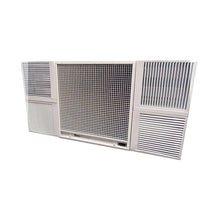
This is where you'll see a special "blend" in high-end filters, often containing potassium permanganate. This is an oxidizer (you'll recognize it as the purple-colored granules mixed in with the black carbon). The Everclear CM-11 has this level of filter available as an option.
Potassium permanganate doesn't work by adsorption. It works by chemical reaction. As specific gases that carbon struggles with (like formaldehyde, hydrogen sulfide, and other low-molecular-weight VOCs) pass over it, the potassium permanganate oxidizes them, breaking them down and converting them into harmless, odorless byproducts.
A blended filter of "carbon/potassium permanganate" is the ultimate solution. The carbon adsorbs the bulk of the VOCs, and the potassium permanganate chemically destroys the tricky ones that get by.
The Only Real Solution: A Dual-Filter System
By now, the solution should be clear. To truly combat cigar smoke, you cannot choose between HEPA and carbon. You must use both, in a robust, commercial-grade system.
-
A "True" HEPA Filter: This is your particle defense. It will remove the visible haze, the PM2.5, the tar, and the soot. This is what keeps the air clear and your walls clean.
-
A Massive Activated Carbon Filter: This is your gas defense. It is the best and only filter for cigar smoke odor. It will adsorb the thousands of invisible VOCs that create the smell.
This dual-system is the only way to win the war on both fronts—to make your air as clean as it looks.
Don't waste money trying to solve a chemical gas problem with a particle filter. Invest in a system that is built to handle both.
To find units with the heavy-duty carbon filters required, read our ultimate buyer's guide for cigar lounge air purifiers.
Frequently Asked Questions (FAQ)
Q: Can't I just wash my carbon filter? A: No. Unlike a simple dust filter, a carbon filter cannot be washed, vacuumed, or "recharged." The process of adsorption is a physical and chemical bond at a microscopic level. Once the filter is saturated, the only solution is to replace the carbon.
Q: How do I know when my carbon filter is "full" and needs to be replaced? A: Your nose will tell you. The most obvious sign is that the stale smoke smell will begin to return, even when the purifier is running. This is the "breakthrough" the EPA describes, where the VOCs are passing through the saturated filter. In a commercial lounge, you should budget to replace your carbon filters every 9-18 months, depending on smoke volume.
Q: Will an ozone generator get rid of the smell? A: We strongly advise against ozone generators. While they are marketed to "destroy" odors, the EPA clearly states that ozone is a toxic gas and a powerful lung irritant. Using one simply trades one health hazard for another and is not a safe or effective long-term solution for an occupied space.