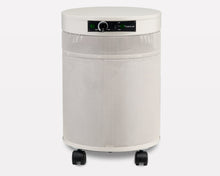
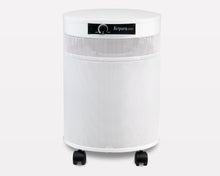
Cigar Smoke Eaters: How They Work & Which to Buy

By the Team at Commercial Air Purifiers
“Smoke eater” is the term the trade uses for a commercial machine built to do one job: pull cigar and cigarette smoke out of the air continuously, all night, without choking on tar or holding onto odor. It is not a scaled-up home air purifier. Most true smoke eaters are built around a specific technology — electrostatic precipitation — that works differently from the HEPA-and-carbon units you'll find elsewhere. This guide explains how electrostatic smoke eaters work, what they cost to run, and which ones to buy for a lounge, bar, or home cigar room.
(If you're comparing the smoke-eater category against HEPA air purifiers to decide which technology to buy at all, start with Smoke Eaters vs. Air Purifiers. This article is about the smoke-eater machine itself.)
How an electrostatic smoke eater works
Cigar smoke is a two-phase contaminant. The visible “blue haze” is particulate — microscopic ash and tar particles, much of it PM2.5, that float for hours and settle as a sticky yellow film. The invisible part is gas-phase: volatile organic compounds (VOCs) like benzene, formaldehyde, and ammonia. The CDC counts thousands of chemical compounds in secondhand smoke. A smoke eater has to attack both phases and survive the tar while doing it.
Electrostatic precipitation handles the particulate phase without a disposable filter. Here's the sequence air follows through the machine:
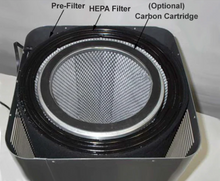
- Pre-filter (the tar barrier): A washable metal-mesh or oil-mist pad condenses and traps the sticky tar first, before it can foul the rest of the machine. This is critical — wet tar hitting a media filter seals it shut like glue.
- The charging field (ionizer): Smoke particles pass through a section of charged wires that give each particle a strong electrical charge.
- The collector cell: The now-charged particles flow between a stack of closely spaced metal collector plates carrying the opposite charge. Opposite charges attract, so the particles slam onto the plates and stay there — pulled out of the airstream entirely.
- The carbon stage (the odor phase): A separate deep bed of granular activated carbon adsorbs the gas-phase VOCs and odor that the plates don't touch.
The key difference from a HEPA machine is the collector: it's a washable aluminum cell, not a filter you throw away. When it fills with captured smoke, you pull it, wash it, dry it, and slide it back in. That single design choice drives most of the cost and maintenance story below.
Why the housing has to be steel, not plastic
Cigar tar is acidic and sticky, and it bonds to plastic. A plastic home purifier slowly absorbs smoke odor until the machine itself becomes the smell. Real smoke eaters use powder-coated or stainless steel: metal is non-porous, so tar sits on the surface and wipes off with a degreaser. A steel unit never holds odor, and it stands up to years of wiping down and cell washing. If a “smoke eater” is molded plastic, it's a home purifier wearing a costume.
The real advantage: cost of ownership
The reason established cigar lounges overwhelmingly run electrostatic smoke eaters comes down to what they cost to keep running. A HEPA machine of the same capacity does the same particle-cleaning job, but you buy new HEPA filters on a schedule forever. With electrostatic, the collector cell is the filter, and you wash it instead of replacing it.
- Collector cells: washed on a cycle (often every 4–8 weeks in heavy use), not replaced. That's labor instead of a parts bill.
- Carbon stage: still a consumable — the carbon adsorbs VOCs until it saturates and must be replaced (roughly every 3–4 months in a busy commercial lounge, 6–9 months in a home room). Trust your nose: if the room smells stale the next morning, the carbon is spent.
- Pre-filters: cheap, washed or swapped frequently to protect the cell.
The trade-off is discipline. An electrostatic smoke eater is only as good as its last cleaning. Let the cells go months past due and collection efficiency drops, and neglected cells can start to produce a faint ozone smell. Modern units are engineered to minimize ozone and, properly maintained, operate within safe limits — but you have to actually do the washing. If nobody on staff will keep that schedule, a sealed HEPA-and-carbon unit that just needs a filter swap may suit you better.
What to avoid: ozone generators
You'll see “ozone generators” marketed to smokers because they destroy odor instantly. Don't. Ozone is a lung irritant, and the EPA explicitly advises against running ozone generators in occupied spaces. Running ozone while people are smoking — already irritating their lungs — is the wrong direction entirely. An electrostatic smoke eater is not an ozone generator; it's a mechanical collection device with a carbon stage, and that's the safe, effective approach.
Sizing: the CFM rule
In an ordinary room, 4 air changes per hour (ACH) is considered good. A cigar room needs far more, because smoke rises on its own heat and hangs. Aim for 15–20 ACH — the whole room's air scrubbed every three to four minutes. Size by air volume, not the square-footage number on the box:
Room volume (L × W × H) × target ACH ÷ 60 = required CFM
Example: a 15 ft × 20 ft den with 10 ft ceilings is 3,000 cubic feet. At 15 ACH: 3,000 × 15 ÷ 60 = 750 CFM. Buy for headroom — a unit rated 1,000+ CFM run on medium delivers that 750 CFM quietly, which keeps the lounge relaxing instead of loud. Our CFM Calculator does the math from your room dimensions.
Installation: mount it high
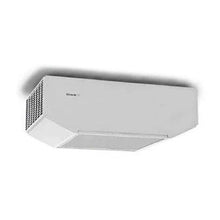
Cigar smoke is hot and rises, so a smoke eater belongs near the ceiling. In lounges and bars we almost always recommend ceiling-mounting the unit flush in the center of the room: it draws smoke up from where it naturally pools and pushes clean air out toward the walls in a donut-shaped pattern, moving smoke away from faces and into the machine. Never sit a smoke eater on the floor — the smoke has to rise, cool, and fall before a floor unit can catch it, and everyone breathes it first. If ceiling mounting isn't possible, get the intake as high as you can on a shelf or pedestal.
Which smoke eater should you buy?
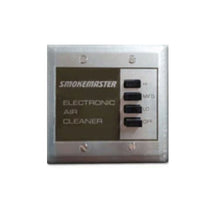
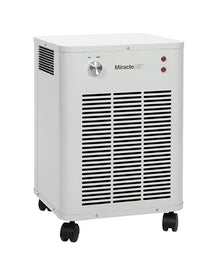
We're a direct dealer for the American-made lines built for this, and for electrostatic specifically the Smokemaster line is the field-proven workhorse — the company has made commercial electrostatic smoke eaters since the 1970s, with floor-standing and ceiling-mount models sized from small lounges up to large cigar bars. For operators who'd rather swap a filter than wash a cell, we also carry HEPA-and-carbon smoke eaters from MiracleAir, EverClear, and LakeAir.
- Home cigar room: a single ceiling-mount or high-shelf unit sized to hit ~15 ACH for your room volume.
- Commercial lounge or bar: electrostatic for the lowest running cost, sized (often multiple units) to 15–20 ACH across the whole floor, with 20+ lbs of carbon in the odor stage.
Browse the Smoke Removal collection for every model we stock, or email info@commercialairpurifiers.net with your room dimensions and peak smoker count and we'll size and quote it the same business day. As a direct dealer, pricing is at manufacturer rates without distributor markup.
Frequently asked questions
Can't I just use an exhaust fan? You can, but it's expensive to run. Exhausting 1,000 CFM means paying to heat or cool 1,000 CFM of makeup air coming back in. A recirculating smoke eater cleans the air without dumping your conditioned air outside.
What about the yellow already on my walls? That's thirdhand smoke — tar that has permeated the paint. A smoke eater prevents new buildup by capturing tar before it settles, but it can't scrub drywall. Wash and repaint, then let the smoke eater protect the new finish.
How long do the cells and carbon last? Cells are washed on a cycle (every 4–8 weeks in heavy use) and last for years. Carbon is replaced every 3–4 months in a commercial lounge, 6–9 months in a home room.
Related guides
- Smoke Eaters vs. Air Purifiers: What's the Best Choice for a Cigar Bar?
- Best Cigar Air Purifiers: What Actually Works
- The Buyer's Guide to Commercial Air Purifiers for Cigar Lounges
- How to Calculate CFM & ACH for a Cigar Lounge
References: CDC, “Secondhand Smoke (SHS) Facts.” ASHRAE, “Standard 62.1: Ventilation for Acceptable Indoor Air Quality.” U.S. EPA, “Residential Air Cleaners: A Technical Summary.”