Best Cigar Air Purifiers: What Actually Works (2026)

By Dan Hennessy, Co-Founder & Editor — Updated 2026
Search “best cigar air purifier” and you get a wall of $300–$800 plastic boxes with five-star reviews written by people who have never sat in a room with three lit Churchills. We sell commercial smoke eaters for a living — we're a direct dealer for Smokemaster, MiracleAir, EverClear, and LakeAir — and we can tell you plainly: almost none of those consumer units will keep up with cigar smoke. This guide explains why, what actually works, and how to pick the right unit for your room without overpaying or under-buying.
TL;DR — the short version
- Cigar smoke is a different problem than dust or pollen. It's a heavy, continuous load of fine particles plus gas-phase chemicals and odor. You need real particle filtration and a serious carbon bed — not one or the other.
- The three specs that matter are airflow (CFM), true HEPA particle filtration (99.97% at 0.3 microns), and activated carbon by weight (20+ lbs for commercial use, not a few ounces).
- Size for air changes, not square footage. Cigar rooms want 15–20 air changes per hour (ACH), far more than the ~4 ACH a home unit targets.
- Avoid ozone generators in occupied rooms, and treat electrostatic/electronic cleaners as viable only if you'll actually keep up the cleaning schedule.
- Our recommendation: a commercial-grade unit with true HEPA plus a deep-bed carbon canister. Browse the Smoke Removal collection or use our CFM Calculator to size it.
Why cigar smoke defeats ordinary air purifiers
A cigar burns for 60 to 90 minutes and produces smoke the entire time. That smoke isn't one thing — it's two problems in one cloud. The visible haze is particulate matter, much of it PM2.5 (particles 2.5 microns and smaller) that hangs in the air for hours and settles into every fabric in the room. The part you can't see is gas-phase: the CDC counts more than 7,000 chemical compounds in tobacco smoke, and the odor-causing volatile organic compounds (VOCs) among them slip straight through a particle filter as if it weren't there.
A typical big-box home purifier is built for the first problem at a small scale and ignores the second almost entirely. Three failures show up again and again:
- Not enough airflow. Premium residential units top out around 300–400 CFM on their highest, loudest setting. A cigar room needs far more moving air than that to hit a meaningful air-change rate.
- A token carbon filter. Most consumer units carry a thin carbon-dusted screen — a few ounces of material. Against the continuous VOC load of cigars it saturates in days, and once saturated it stops working (and can even release odor back into the room).
- Plastic everything. Cigar tar is sticky and it coats interior plastic surfaces, which then hold odor. Commercial units are built largely from metal for exactly this reason — that's the “heavy metal” you actually need to handle the haze.
The three specifications that actually matter
1. Airflow (CFM) — size by air changes, not square feet
CFM (cubic feet per minute) is how much air a unit pushes through its filters. What you care about is how many times per hour it can clean the entire volume of your room — the air-change rate, or ACH. A normal room is designed for about 4 ACH. That is nowhere near enough for cigars. For an active cigar room you want 15–20 ACH, which cleans the full room every three to four minutes.
The math is simple:
Room volume (L × W × H) × target ACH ÷ 60 = required CFM
Worked example: a 15 ft × 20 ft room with 10 ft ceilings is 3,000 cubic feet. At 15 ACH: 3,000 × 15 ÷ 60 = 750 CFM. A single 300–400 CFM home unit gets you less than half of that; you'd need three of them. One commercial unit rated 1,000+ CFM handles the same room comfortably — and lets you run it on medium (quieter, longer filter life) instead of pinning a small unit on turbo all night. Our CFM Calculator does this math for you.
2. True HEPA for the particles
For the visible haze and the fine PM2.5, you want true HEPA: filtration certified to capture 99.97% of particles at 0.3 microns, the hardest-to-catch particle size. Watch the label. “HEPA-type,” “HEPA-like,” and “99% at 2 microns” are marketing terms for cheaper media that let the finest, most damaging particles through. For cigars, accept nothing less than true HEPA.
3. Activated carbon — measured in pounds, not presence
Carbon is what removes odor and VOCs, and the only spec that matters is weight. Commercial cigar units use deep-bed carbon canisters holding 15–30 pounds of granular activated carbon, often blended with potassium permanganate for extra gas-phase adsorption. As a rule of thumb, look for at least 10 lbs for a home cigar room and 20+ lbs for commercial use. If a spec sheet won't state the carbon weight in pounds, the carbon stage isn't a real part of the design.
The tar-clog and desorption traps
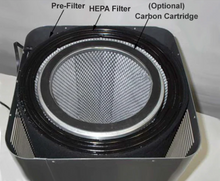
Two failure modes specific to cigars are worth calling out. First, tar clog: cigar tar is sticky, and without a proper pre-filter it seals the face of a HEPA filter, choking airflow and killing performance in weeks. A good three-stage stack — pre-filter, carbon, then HEPA — protects the expensive filters and is why commercial units last. Second, desorption: a saturated carbon filter doesn't just stop adsorbing, it can begin re-releasing captured odor back into the room. That faint sour, stale-smoke smell from an old filter is desorption. It's the reason carbon replacement schedules matter (roughly every 3–4 months in a busy commercial setting; 6–9 months in a home room used a few times a week).
Which technology? A quick verdict
| Technology | Verdict | Why |
|---|---|---|
| True HEPA | Essential | The only reliable way to capture the fine particulate haze and PM2.5. |
| Deep-bed activated carbon | Essential | The only thing that removes gas-phase VOCs and odor. Non-negotiable for cigars. |
| Electrostatic / electronic cells | Use with care | Washable collector plates lower long-term filter cost, but they only work if you clean them on schedule (often weekly in heavy use). Skip the maintenance and performance falls off fast. |
| Ozone generators | Avoid | Ozone (O₃) is a lung irritant. The EPA warns against running ozone generators in occupied spaces. It masks odor rather than removing the source, and it isn't safe around guests or staff. |
Placement: don't create a dead zone
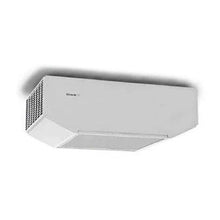
Even the right unit underperforms if it's parked in a corner behind furniture. Air needs a path to circulate. If your room is large or oddly shaped, two medium units on opposite walls will out-clean one big unit crammed in a single corner — you eliminate the stagnant “dead zone” where smoke lingers. Ceiling-mounted units are excellent for lounges because they distribute air across the whole room and keep the floor clear. And remember an air purifier is a recirculation device: it cleans the air already in the room. If you're also running an exhaust fan, make sure you have makeup air to match (a 1,000 CFM exhaust needs roughly 1,000 CFM of replacement air coming in), or the fan will starve and pull unfiltered air from wherever it can.
So what should you actually buy?
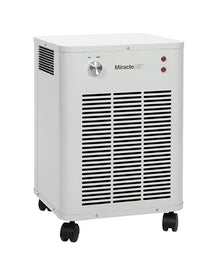
For a home cigar room, look for a metal-bodied unit rated around 1,000 CFM with true HEPA and at least 10–20 lbs of carbon — enough that you can run it on a lower, quieter speed and still clear the room. For a commercial lounge or cigar bar, plan on 20+ lbs of carbon per unit and size your total system CFM to hit 15–20 ACH for the room's volume, adding units as needed for larger or open-plan spaces.
We carry the American-made lines built for exactly this — Smokemaster, MiracleAir, EverClear, and LakeAir. The Smoke Removal collection has every model we stock for cigar applications, and if you'd rather just tell us your room dimensions and peak smoker count, email info@commercialairpurifiers.net and we'll size it and quote it the same business day. As a direct dealer, our pricing is at manufacturer rates without distributor markup.
Related guides
- The Buyer's Guide to Commercial Air Purifiers for Cigar Lounges
- Cigar Smoke Eaters: How They Work & Which to Buy
- How to Remove Cigar Smoke & Odor: The Definitive Guide
- Why HEPA Isn't Enough: The Role of Activated Carbon for Cigar Smoke
- How to Build a Professionally Ventilated Home Cigar Room
Dan Hennessy co-founded Commercial Air Purifiers, LLC. The company is a direct dealer for Smokemaster, MiracleAir, LakeAir, and EverClear.